GZCLP: the complete guide with a real example week (2026)
How GZCLP works: T1, T2 and T3 tiers, the 5x3+ → 6x2+ → 10x1+ stages, starting weights, a full example week in kg and lb, and what to do when you stall.

GZCLP is the program most people move to when straight 5x5 starts to grind. Cody Lefever designed it as a linear progression built around one idea: a bad day shouldn’t cost you weight. Instead of deloading after a miss, the lift changes shape and keeps climbing.
This guide covers the whole program: the three tiers, the stages, how to pick starting weights, a full example week, and what to do when a lift finally stalls.
The three tiers
Every GZCLP workout pairs three kinds of work, each with its own job.
| Tier | Job | Starting scheme | Weight |
|---|---|---|---|
| T1 | Heavy strength | 5x3+ (last set AMRAP) | ~85% of your 5-rep max |
| T2 | Volume | 3x10 | ~75% of your T1 weight |
| T3 | Accessory | 3x15+ (last set AMRAP) | Light, clean reps |
The four main lifts (squat, bench press, overhead press and deadlift) each appear twice per rotation: once as a heavy T1 and once as a T2 volume lift.
The four workouts
| Day | T1 (heavy) | T2 (volume) | T3 (accessory) |
|---|---|---|---|
| A | Squat | Bench press | Lat pulldown |
| B | Overhead press | Deadlift | Dumbbell row |
| C | Bench press | Squat | Lat pulldown |
| D | Deadlift | Overhead press | Dumbbell row |
Run the days in order (A, B, C, D, then back to A) whether you train three or four days a week. Every lift gets a heavy exposure and a volume exposure in each rotation.
Progression: add weight, and change stage when you miss
When you complete all target reps, add weight next time you do that lift in that tier:
- Squat and deadlift: +5 kg (+10 lb)
- Bench and overhead press: +2.5 kg (+5 lb)
When you miss reps, you do not deload. The lift moves to its next stage at the same weight:
| Tier | Stage 1 | Stage 2 | Stage 3 | After stage 3 fails |
|---|---|---|---|---|
| T1 | 5x3+ | 6x2+ | 10x1+ | Restart 5x3+ at ~85% |
| T2 | 3x10 | 3x8 | 3x6 | Restart 3x10 at your last 3x10 weight + 7.5 kg (15 lb) |
The total reps stay similar (15, 12 and 10 for T1), but each rep gets easier to complete. That buys you several more sessions of adding weight before a reset, and the reset itself lands you heavier than where you started.
T3 progresses differently: stay on 3x15+ and add weight when the last set reaches 25 reps.
The AMRAP set
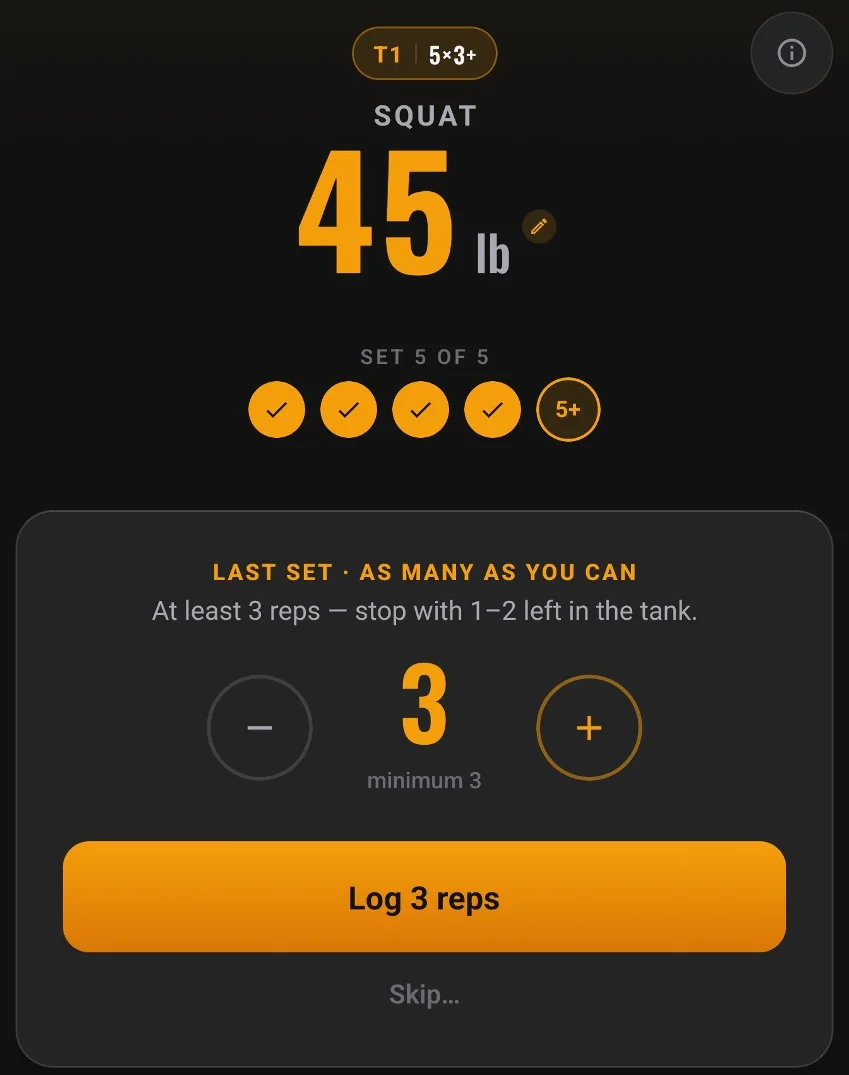
The last set of T1 (and T3) is marked with a +. Do the target reps, then keep going while your form holds. Stop with one or two good reps left in the tank: the AMRAP is a strength signal, not a test to failure.
Your AMRAP reps tell you how the program is going. If the last set of 5x3+ keeps landing on 6-8 reps, you have room to grow. If it drops to exactly 3, a stage change is probably coming soon.
Starting weights
Coming from 5x5 or StrongLifts: use your current 5x5 working weights for T1. They sit close to 85% of a fresh 5-rep max, which is where GZCLP wants you. Start T2 at about 75% of those numbers, rounded down to weights you can load.
Starting fresh: find a weight you can lift for five clean reps, take 85% of it for T1, and start T2 at 65-75% of that. Starting light is fine. The early sessions go fast and let you groove technique.
A full example week
A lifter coming off 5x5 with squat 80 kg (175 lb), bench 55 kg (120 lb), overhead press 40 kg (90 lb) and deadlift 100 kg (220 lb):
| Day | Lift | Tier | Sets x reps | Weight |
|---|---|---|---|---|
| A | Squat | T1 | 5x3+ | 80 kg / 175 lb |
| A | Bench press | T2 | 3x10 | 40 kg / 90 lb |
| A | Lat pulldown | T3 | 3x15+ | your choice |
| B | Overhead press | T1 | 5x3+ | 40 kg / 90 lb |
| B | Deadlift | T2 | 3x10 | 75 kg / 165 lb |
| B | Dumbbell row | T3 | 3x15+ | your choice |
| C | Bench press | T1 | 5x3+ | 55 kg / 120 lb |
| C | Squat | T2 | 3x10 | 60 kg / 130 lb |
| C | Lat pulldown | T3 | 3x15+ | your choice |
| D | Deadlift | T1 | 5x3+ | 100 kg / 220 lb |
| D | Overhead press | T2 | 3x10 | 30 kg / 65 lb |
| D | Dumbbell row | T3 | 3x15+ | your choice |
If every set is completed, the next rotation starts with squat T1 at 85 kg (185 lb). If the bench T2 on day A missed reps on its last set, it moves to 3x8 at the same 40 kg next time. Nothing gets lighter.
Rest times
- T1: 3-5 minutes. These are heavy sets, so recover properly.
- T2: 2-3 minutes.
- T3: 60-90 seconds. Accessories are about volume, not recovery.
GZCLP vs 5x5
Both are linear progressions and both build the same lifts. The main differences are how they handle misses and how much work they include:
- 5x5 deloads 10% after repeated misses. GZCLP changes the rep scheme first and resets only after three stages.
- GZCLP adds a volume tier and an accessory tier, so there’s more total work and more upper-back training.
- 5x5 is simpler to start. GZCLP asks you to track three schemes and two kinds of progression.
For the full breakdown, read 5x5 vs GZCLP. If your linear progression is fully used up, Madcow 5x5 and the Texas Method are the weekly-progression options.
Running GZCLP in Lift5x5
Tracking GZCLP on paper means keeping three schemes, two stage counters per lift and a restart rule in your head. Lift5x5 runs GZCLP as a Pro program and does that bookkeeping for you:
- Every set shows its tier and scheme. The last T1 and T3 set gets an AMRAP counter, so you log the exact reps you did.
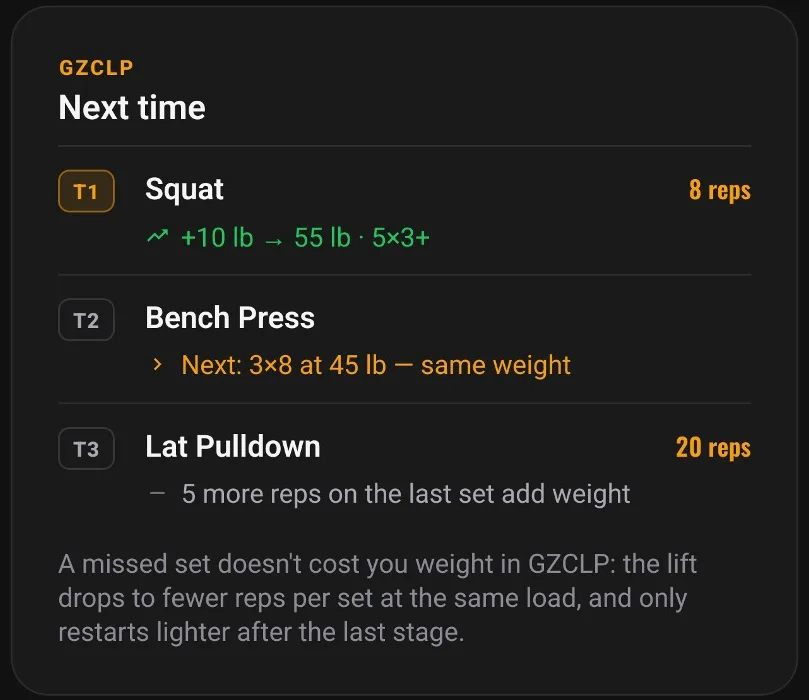
- After each workout, a report shows what happens next time for every lift: the new weight, the next stage, or how many reps your T3 needs before it goes up.
- Weights are rounded to plates you can actually load, in kg or lb, and your 5x5 working weights carry over when you switch.
Track your 5x5 progress automatically
Built-in plate calculator, rest timer, and auto-progression. Free for iOS & Android.
Frequently asked questions
Is GZCLP good for beginners?
Yes. GZCLP is a linear progression program, so it works from day one, but it shines most for lifters who have run 5x5 or a similar program for a few months and are starting to miss reps. Its stage system turns those misses into more weeks of progress instead of immediate deloads.
How many days a week is GZCLP?
The four workouts rotate, and most people train three or four days a week. On three days a week each lift gets a heavy day and a volume day every nine to ten days, which is plenty for a novice to intermediate lifter.
What does the + mean in 5x3+?
The + marks the last set as an AMRAP: as many reps as possible. Do at least the target (3 reps), then keep going while your form holds, and stop with one or two reps left in the tank. The extra reps are a record of how strong you are getting.
What happens when I fail 10x1+?
The lift restarts at 5x3+ with a lighter weight. The original rule is to rest a couple of days, test a new 5-rep max and restart at 85% of it. A simpler version that many lifters and apps use is to restart at 85% of the weight you failed with.
What should I pick for T3?
Upper-back and pulling work fits best, because the T1 and T2 lifts already cover squat, bench, overhead press and deadlift. Lat pulldowns and dumbbell rows are the classic defaults. Pick something you can do for 15 or more reps with good form.
Can I run GZCLP in kg?
Yes. Add 5 kg per successful session to squat and deadlift and 2.5 kg to bench and overhead press. The restart bump for T2 is 7.5 kg. In pounds those numbers are 10 lb, 5 lb and 15 lb.
Writes the Lift5x5 training blog. Over a decade under the bar running 5x5-style programs — practical strength advice with no BS, just barbells.
More about Erik →