Rack pulls: how to use them for deadlift gains
Rack pulls build lockout strength, upper back mass, and let you handle heavier weight than full deadlifts. Setup, programming, and common mistakes.
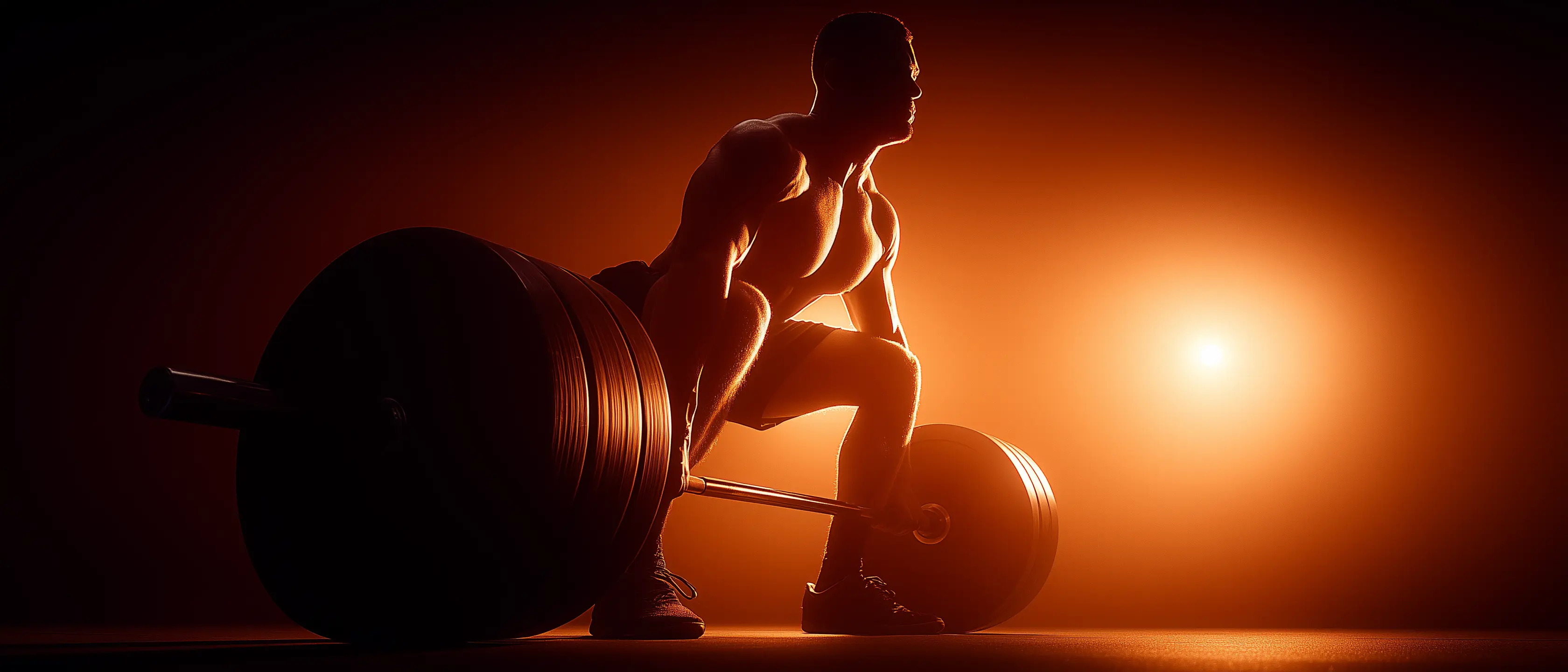
Your deadlift stalls. You can break the bar off the floor fine, but somewhere between your knees and lockout, the bar slows to a crawl and then stops. You grind, you strain, and either you barely finish the rep or you don’t finish it at all.
This is a lockout problem. The muscles responsible for the top half of the deadlift — your upper back, traps, glutes, and hip extensors — aren’t strong enough to finish what your legs started. And the most effective way to target that weak point is to train it directly with more weight than you can handle from the floor.
That’s what rack pulls do.
What rack pulls are
A rack pull is a deadlift performed from an elevated starting position. Instead of pulling from the floor, the bar starts on the safety pins of a power rack, usually set somewhere between mid-shin and mid-thigh height.
By shortening the range of motion, you eliminate the hardest part of the initial pull (breaking the bar from the floor) and focus exclusively on the lockout portion. This lets you load the bar significantly heavier than your full deadlift — typically 10-30% more — which creates a unique training stimulus.
The movement itself is identical to the top portion of the deadlift — one of the five foundational 5x5 exercises: hinge at the hips, grip the bar, brace, and drive your hips forward until you’re standing straight.
Why rack pulls work
Rack pulls aren’t just partial deadlifts done for ego. They provide three specific benefits that full deadlifts can’t replicate as effectively.
Overload for neural adaptation
Your nervous system is conservative. It limits how much force your muscles can produce based on what it considers safe. Training with supramaximal loads — weights heavier than your full deadlift max — teaches your nervous system that heavy weight is manageable. This neural adaptation carries over to your full deadlift, making heavy weights feel less intimidating and improving your ability to recruit muscle fibers under maximal loads.
This is the same principle behind other overload methods like walkouts with heavy squats. Exposure to heavy weight, even through a reduced range of motion, builds confidence and neural drive.
Upper back and trap development
The upper back and traps are responsible for keeping your torso rigid during the lockout. When these muscles are weak, your upper back rounds under heavy loads, the bar drifts forward, and the lift fails.
Rack pulls hit the upper back and traps with more weight than any other exercise. The isometric demand on your spinal erectors and the concentric force required from your traps to finish the lockout at supra-maximal weights produces significant strength and hypertrophy gains in these muscles.
Targeted lockout practice
If your deadlift consistently fails at the same point — between the knees and lockout — you need more practice in that exact range of motion under heavy load. Full deadlifts from the floor give you one shot at the lockout after you’ve already fatigued yourself pulling from the floor. Rack pulls let you practice the lockout fresh, with heavier weight, for more reps.
How to set up rack pulls
Setup is straightforward, but the details matter. Poor setup turns rack pulls into a sloppy, ineffective exercise.
Pin height
This is the most important variable. Where you set the pins determines what portion of the deadlift you’re training.
Just below the knee: this is the sweet spot for most lifters. It covers the range of motion from mid-shin to lockout, which includes the transition point where most deadlift failures occur. Start here unless you have a specific reason not to.
At the knee: focuses specifically on the lockout phase. Less range of motion, heavier loading. Useful if your sticking point is genuinely at or above the knee.
Above the knee (mid-thigh): very short range of motion. Allows extremely heavy loading but has limited carryover to full deadlifts. This height is mostly useful for getting used to holding very heavy weight (neural overload) rather than building the deadlift pattern.
General rule: the lower the pins, the more the exercise resembles a full deadlift and the more transferable the strength. The higher the pins, the more weight you can use but the less specific the exercise becomes.
Stance and grip
Use the same stance and grip you use for your conventional deadlift. The point of rack pulls is to strengthen the lockout portion of your actual deadlift, so everything should replicate your normal pulling setup.
Feet hip-width apart, bar over mid-foot, grip just outside your legs. Double overhand, mixed, or hook grip — whatever you use for heavy deadlifts.
Setting your back
This is where people get careless. Because the bar is elevated and the weight is heavy, the temptation is to grab the bar and just yank it up. Don’t.
Set up exactly as you would for a full deadlift:
- Chest up, shoulder blades pulled back
- Lower back flat or slightly arched
- Lats engaged (“protect your armpits”)
- Big breath, full brace
The back position is non-negotiable. If your back rounds on rack pulls, the weight is too heavy or you’re not setting up properly. A rack pull with a rounded upper back is just a heavy shrug with extra steps — it doesn’t train the lockout pattern you need.
The pull
Drive your hips forward while keeping the bar close to your body. The bar should travel straight up, dragging along your quads. Squeeze your glutes at lockout and stand tall — full hip extension, shoulders back, knees locked.
Lower the bar back to the pins under control. Don’t drop it — the eccentric portion has training value. Reset your position on the pins before each rep. Dead stop, not touch-and-go.
Rack pulls vs block pulls
You’ll hear these terms used interchangeably. They’re similar but not identical.
Rack pulls: bar starts on the safety pins of a power rack. The pins are rigid steel, which means the bar starts from a dead stop with zero bounce or give.
Block pulls: bar starts on raised blocks or mats placed on the floor. The blocks can vary in material — rubber mats, wooden blocks, stacked bumper plates. There’s slightly more give and a less consistent starting height.
For training purposes, both work. Rack pulls are more convenient if you have a power rack. Block pulls are an option if your gym’s rack isn’t configured for pulling from inside it.
The one real advantage of block pulls: the bar isn’t hitting steel pins, which is easier on the barbell and the rack. Some gyms prefer block pulls for equipment longevity.
Programming rack pulls
Rack pulls work best as a secondary movement after your main deadlift or as a deadlift variation during specific training phases.
Option 1: after main deadlifts
Perform your normal 1x5 deadlift on 5x5, then add rack pulls:
Sets and reps: 3 sets of 3-5 reps Weight: start at your deadlift working weight and add 10-20%. Adjust based on how the reps look — if your back rounds, it’s too heavy. Pin height: just below the knee
This adds 5-8 minutes to your deadlift session and provides targeted lockout work while the muscles are warmed up.
Option 2: deadlift variation during plateaus
If your deadlift has stalled and you’ve already tried the standard approaches (deload, form check, rest), you can replace your main deadlift with rack pulls for 2-3 weeks:
Sets and reps: 3-5 sets of 3-5 reps Weight: 100-120% of your stalled deadlift weight Pin height: just below or at the knee
After the rack pull block, return to full deadlifts. The lockout strength and neural adaptation from handling heavier loads often breaks through the stall. This is a common approach for intermediate lifters who have hit a plateau on their deadlift.
Option 3: heavy singles for neural overload
For advanced lifters who want to build comfort with maximal loads:
Sets and reps: work up to a heavy single (1 rep max from pins) Pin height: at the knee or slightly above Frequency: once every 1-2 weeks, not as a regular training staple
This isn’t about building muscle. It’s about teaching your nervous system what heavy weight feels like. Handle 120-140% of your floor deadlift on rack pulls, and your actual max feels lighter by comparison.
Common mistakes
Hitching and leaning back
The most common form breakdown on rack pulls. Instead of driving the hips through to lockout, the lifter leans back and hitches the bar up their thighs in a jerky, segmented motion.
Hitching is inefficient, reduces training stimulus to the target muscles, and puts your lower back in a compromised position. If you can’t complete the rep with a smooth hip drive, the weight is too heavy.
Setting pins too high
Rack pulls from mid-thigh with 300 kg look impressive on social media. They don’t build deadlift strength. The range of motion is so short that the exercise becomes a glorified barbell hold with a slight hip thrust. The strength built in a 3-inch range of motion doesn’t transfer to a full deadlift.
Keep pins at or below the knee for meaningful training stimulus.
Ego loading
Because you can rack pull more than you can deadlift, it’s tempting to pile on weight until form disintegrates. Remember the purpose: build the lockout portion of your deadlift with proper mechanics. A 200 kg rack pull with a tight, flat back is infinitely more valuable than a 260 kg rack pull with a rounded back and a hitch.
Bouncing off the pins
Each rep should start from a dead stop on the pins. Bouncing the bar off the pins uses the elastic energy of the collision to generate momentum, which defeats the purpose of training the weakest portion of the pull. Set the bar down, reset your position, then pull.
Who benefits most from rack pulls
Not every lifter needs rack pulls. They’re a specific tool for a specific problem.
You should add rack pulls if:
- Your deadlift consistently fails between the knees and lockout
- Your upper back rounds under heavy loads
- You’ve been stuck at the same deadlift weight for 3+ weeks despite good recovery
- You want to build upper back and trap mass
You probably don’t need rack pulls if:
- Your deadlift is still progressing linearly (the 5x5 program is still working)
- You fail off the floor, not at lockout (deficit deadlifts or pause deadlifts are better for this)
- You’re a beginner with less than 6 months of training (focus on full range of motion deadlifts)
As with all accessories, rack pulls are most valuable when they address a diagnosed weak point. Random addition of exercises without a clear purpose just adds fatigue. Identify your deadlift sticking point first, then choose the tool that targets it.
For more on building a bigger deadlift and diagnosing where your pull breaks down, check the complete guide. And for technique breakdowns on all five lifts, visit the exercise guide.
Track your 5x5 progress automatically
Built-in plate calculator, rest timer, and auto-progression. Free for iOS & Android.
Frequently asked questions
Are rack pulls better than deadlifts?
No. Rack pulls are an accessory that complements full deadlifts, not a replacement. Full deadlifts train the entire pull from the floor, including the initial break and the transition through the knees — which rack pulls skip entirely. Use rack pulls to target specific weaknesses in the lockout. Your main deadlift training should still be full range of motion pulls from the floor.
What height should I set the pins?
Just below the knee gives the most carryover to full deadlifts because it covers the range of motion where most people fail. At the knee works the lockout phase specifically. Above the knee reduces range of motion too much for most training purposes and tends to encourage ego loading with sloppy form. Start with pins just below the knee and adjust based on where your deadlift stalls.
How much more can I rack pull than deadlift?
With pins at or just below the knee, most lifters handle 10-30% more than their full deadlift. The exact number depends on your proportions and where your deadlift weak point is. If you fail at lockout on full deadlifts, the gap will be smaller. If you struggle off the floor but have a strong back, the gap will be larger.
Do rack pulls build muscle?
Yes. Rack pulls are excellent for building the upper back, traps, and spinal erectors because you can load them heavier than full deadlifts. The heavy partial range of motion creates significant mechanical tension in these muscles. Many bodybuilders and strength athletes use rack pulls specifically for upper back hypertrophy.
Can rack pulls replace deadlifts during a deload?
They can work as a lighter deadlift variation during a deload, but only if you use moderate weight (around 60-70% of your full deadlift) and focus on positions and technique. Using heavy rack pulls during what's supposed to be a recovery week defeats the purpose of deloading. If you're taking a proper deload, light conventional deadlifts are usually a better choice.
Writes the Lift5x5 training blog. Over a decade under the bar running 5x5-style programs — practical strength advice with no BS, just barbells.
More about Erik →