How to increase your deadlift
Proven strategies to build a bigger deadlift. Fix weak points, optimize programming, train grip, and add the right accessories for steady progress.
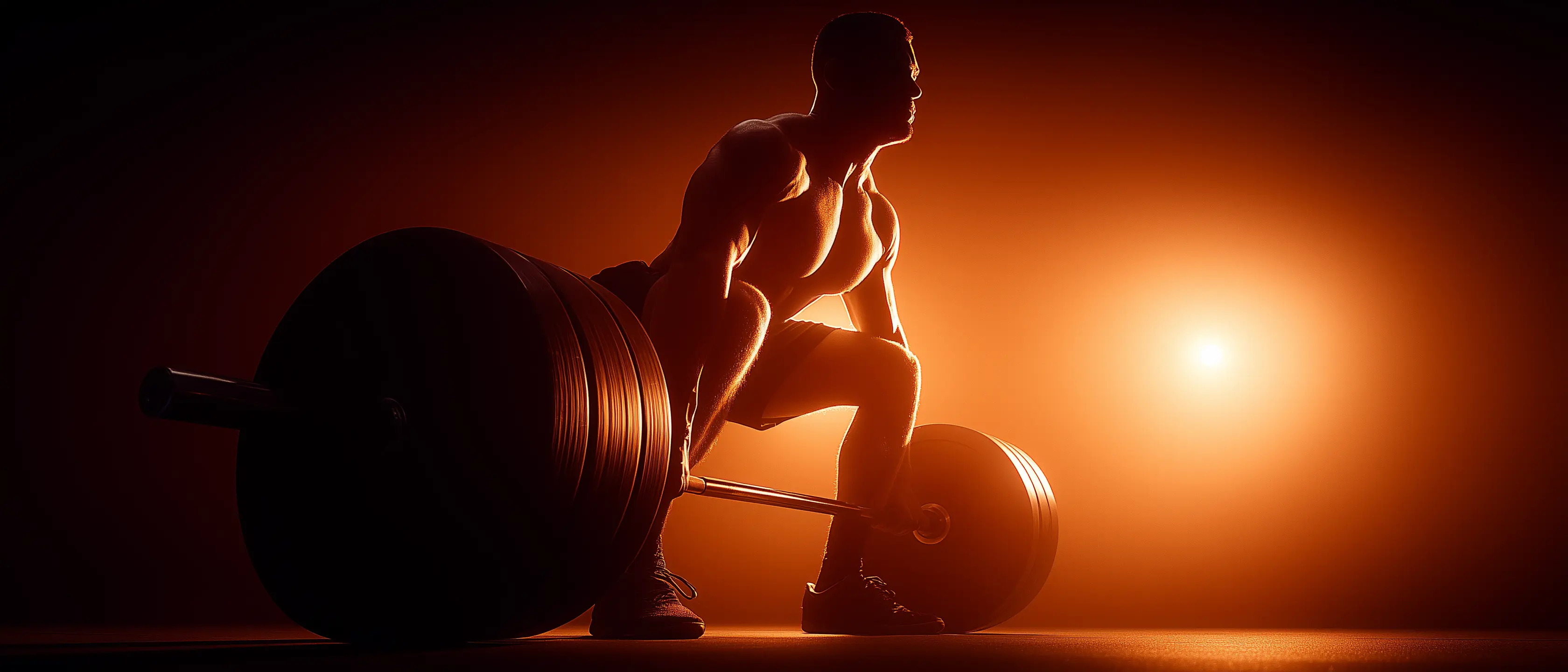
The deadlift is the heaviest of the five main 5x5 exercises and where most people will eventually lift their heaviest weight. It’s also the lift that rewards patience and consistency more than any clever trick.
If your deadlift has stalled or you want to accelerate your progress, the answer usually isn’t pulling more often or trying harder. It’s pulling smarter: fixing your technique, targeting weak points, and managing recovery so your body can actually adapt.
Here’s how to systematically build a bigger deadlift.
Fix your form first
Adding weight to a flawed deadlift doesn’t build strength. It builds compensation patterns that eventually cap your progress or cause injury.
The hip hinge
Every deadlift starts with a hip hinge. If you’re squatting the weight up or stiff-legging it with a rounded back, you’re leaking force.
The hinge means pushing your hips back while maintaining a flat lower back. Your torso angle depends on your proportions, but your spine should stay neutral from start to finish. Film yourself from the side. If your lower back rounds at any point, the weight is too heavy or your positioning needs work.
Bar path
The bar should travel in a straight vertical line. Any forward drift away from your body turns the deadlift into a lower back exercise instead of a full posterior chain movement.
Cues that help:
- “Drag the bar up your legs” - keeps it close
- “Protect your armpits” - engages your lats to pull the bar in
- “Push the floor away” - initiates with legs instead of yanking with the back
If you have scrapes on your shins, you’re doing it right. Wear long socks or pants.
Bracing
Take a deep breath into your belly before every rep. Brace your entire core like you’re about to get punched. This creates intra-abdominal pressure that stabilizes your spine.
Losing your brace mid-rep is one of the most common reasons lifters fail heavy pulls. If you can’t maintain pressure for the entire rep, the weight is too heavy.
For a full breakdown of conventional deadlift setup and execution, start there before applying the strategies below.
Program your deadlifts for strength
Deadlifts respond differently to programming than squats or bench press. Understanding this is key to making progress.
Lower volume, higher intensity
Your posterior chain can handle heavy loads, but deadlifts create more systemic fatigue per rep than any other lift. Five sets of five heavy deadlifts leaves most people unable to train properly for days.
On 5x5, deadlifts are programmed as 1x5 for exactly this reason. That single heavy set, preceded by warm-up sets, provides enough stimulus for adaptation without crushing your recovery.
If your deadlift has stalled, the solution is rarely more volume. It’s usually better technique, targeted accessories, or improved recovery.
Progression strategy
Add 5kg per successful session on 5x5. This is faster progression than your other lifts because:
- The posterior chain recovers well between sessions
- You’re only doing one work set
- Dead-stop reps build pure concentric strength
When linear progression ends, weekly progression schemes like Madcow 5x5 or the Texas Method work well for continued deadlift gains.
Singles and triples
Once you’ve exhausted beginner progression, heavy singles (1-rep sets at 90-95% of your max) and triples (3-rep sets at 85-90%) build the specific strength needed for heavy pulls. These train your nervous system to recruit maximum muscle fiber without the fatigue cost of multiple heavy sets of five.
One or two heavy singles after your work sets, once per week, can break through deadlift plateaus.
Identify and fix your weak points
Where you fail tells you what’s weak. Every sticking point has a specific cause and a specific fix.
Weak off the floor
If the bar barely moves or moves very slowly off the ground, the problem is usually:
Weak quads or poor positioning. The initial pull requires your legs to drive the floor away. If your quads can’t generate enough force in that bottom position, or if you’re starting with your hips too high, the bar stays planted.
Fixes:
- Deficit deadlifts: Stand on a 2-5cm platform and pull. This increases range of motion and strengthens the bottom position. Use 60-70% of your normal weight.
- Pause deadlifts: Pause for 2-3 seconds with the bar 2-3cm off the floor. Builds strength and control in the weakest position.
- Front squats: Strengthen quads specifically, which drive the initial pull.
Weak at lockout
If you can break the bar off the floor but can’t finish the lift at the top, the problem is usually:
Weak glutes, weak upper back, or the bar drifting forward. Lockout requires hip extension (glutes) and maintaining an upright torso (upper back). If the bar gets away from you during the pull, lockout becomes nearly impossible.
Fixes:
- Rack pulls: Set the bar at knee height in a rack and pull to lockout. Use heavier weight than your full deadlift. Trains the specific lockout pattern under load.
- Hip thrusts or heavy glute bridges: Isolate glute strength for hip extension.
- Barbell rows: Build the upper back strength that keeps your torso upright during heavy pulls. Your row form matters here too.
- Block pulls: Similar to rack pulls but pulling from blocks. Lets you overload the top portion.
Weak at the knees
The bar passes the floor but gets stuck around the knees. This is often a positioning issue: the bar has drifted forward, or the hips shot up too fast, leaving you in a bad pulling position.
Fixes:
- Slow down the initial pull and focus on keeping the bar against your legs
- Romanian deadlifts (RDLs) strengthen the hamstrings through the exact range where this stall happens
- Film from the side and watch your hip position at the knee
Train your grip
Grip fails before your back and legs do. This is normal, predictable, and fixable.
Grip progression
Follow this sequence as weights get heavier:
- Double overhand: Both palms facing you. Use this as long as possible. It builds grip strength that transfers everywhere.
- Chalk: Adding chalk to double overhand can extend its usefulness by 10-20kg. Chalk is the single best grip aid.
- Mixed grip: One palm forward, one back. Stronger but creates slight asymmetry. Alternate which hand is supinated between sets to even out.
- Hook grip: Thumb trapped under fingers, both palms facing you. Painful initially but very strong and symmetrical. Olympic lifters use this exclusively.
- Straps: For work sets when grip is the limiting factor and you need to train your back and legs. Don’t use straps for every set - use them strategically.
Building grip strength
Dedicated grip work accelerates your deadlift progress:
- Dead hangs: Hang from a pull-up bar for max time. Aim for 60+ seconds. Simple and effective.
- Farmer’s carries: Heavy dumbbells or a trap bar, walk for 30-40 meters. Trains grip endurance under load.
- Double overhand holds: After your last deadlift set, hold the bar at lockout for as long as you can. Progressive overload for grip.
- Fat grips: Wrap a towel around the bar for warm-up sets. Thicker bar forces harder grip.
Most lifters can double overhand 100kg+ with consistent grip training. That covers months of progression before you need alternative grips.
Add the right accessories
Accessories should address your specific weak points, not just add fatigue. Pick two or three, not eight.
Best deadlift accessories
Romanian deadlifts (RDLs): The single best deadlift accessory. Strengthens hamstrings and teaches the hip hinge pattern under load. 3x8-10 at moderate weight after your deadlifts.
Deficit deadlifts: Increases range of motion and builds bottom-position strength. 3x5 at 60-70% of your deadlift. Stand on a 2-5cm plate or platform.
Rack pulls or block pulls: Overloads the lockout. Use 110-120% of your deadlift for 3x3-5.
Front squats: Builds the quad strength needed to break the bar off the floor. Also strengthens your upper back and core.
Barbell rows: Directly builds the upper back that keeps you upright during heavy pulls. Pendlay rows (from the floor each rep) have the most carryover.
What not to add
Don’t add accessories that compromise your main lifts. If you’re doing 5x5 and adding five accessories, you’ll be too fatigued to progress on your actual deadlift. Two or three exercises, 2-3 sets each, after your main work. That’s it.
Consider sumo vs conventional
If you’ve been pulling conventional and struggling, it’s worth trying sumo deadlift - and vice versa.
Conventional suits: Lifters with shorter torsos, longer arms, and strong lower backs. The bar travels further but leverages the posterior chain.
Sumo suits: Lifters with longer torsos, shorter arms, and strong hips. Shorter range of motion, more upright torso, more hip and quad demand.
Neither is cheating. Neither is inherently stronger. Your body proportions determine which gives you better leverage. Try both for 4-6 weeks and see which feels more natural and lets you lift more.
That said, don’t switch stances every time you stall. Give each style an honest effort before deciding.
Manage recovery
Deadlifts tax your central nervous system more than any other barbell exercise. Recovery isn’t optional - it’s where your strength is actually built.
Sleep
A 2011 study in the European Journal of Applied Physiology found that even moderate sleep restriction (6 hours vs 8 hours) reduced muscular strength by 5-10%. For a 180kg deadlift, that’s 9-18kg lost to poor sleep.
Get 7-9 hours. This isn’t optional advice for serious strength. Read more about sleep and recovery.
Nutrition
You can’t deadlift heavy on a starvation diet. Your body needs fuel to recover and adapt.
Minimum requirements: adequate protein (1.6-2.2g per kg bodyweight), sufficient total calories, and enough carbohydrates to fuel training. For a full breakdown, check the nutrition guide for 5x5.
Deloads
When progress stalls, a planned deload (reducing weight by 10% for a week) lets accumulated fatigue dissipate. Many lifters hit PRs in the week or two following a deload.
If you’re grinding every rep and dreading deadlift day, you probably need a deload more than you need a new program.
Realistic benchmarks
Understanding what’s achievable keeps expectations grounded and prevents frustration.
Beginner (0-6 months): Most healthy adult males can reach 1.25-1.5x bodyweight. Women typically reach 1.0-1.25x bodyweight. Linear progression handles this phase.
Intermediate (6-18 months): 1.5-2.0x bodyweight for men, 1.25-1.75x for women. Weekly progression programs like Madcow or Texas Method.
Advanced (2+ years): 2.0-2.5x bodyweight for men, 1.75-2.25x for women. Periodized programming and significant training commitment.
These are achievable numbers for most people with consistent training, adequate nutrition, and proper recovery. Genetics influence the ceiling, but most people never get close to their genetic potential anyway.
A 2x bodyweight deadlift is a realistic 1-2 year goal for most dedicated trainees. It’s an impressive lift by any standard and proves you’ve built real, functional strength.
The path forward
Building a bigger deadlift comes down to a few principles: pull with excellent technique, target your specific weak points, train your grip, recover properly, and add weight patiently over time.
There’s no secret program or magic accessory. Consistent effort with the basics builds deadlifts that most people would consider impossible. Show up, pull well, eat enough, sleep enough, and trust the process. For proper form on the deadlift and all five lifts, review the exercise guide.
Track your deadlift progression and know exactly when to add weight:
Track your 5x5 progress automatically
Built-in plate calculator, rest timer, and auto-progression. Free for iOS & Android.
Helping lifters get stronger with the simplest program that works. No BS, just barbells.