Deadlift technique for building strength
Learn to deadlift safely and build serious strength. Conventional deadlift setup, execution, common mistakes, and when to add weight.
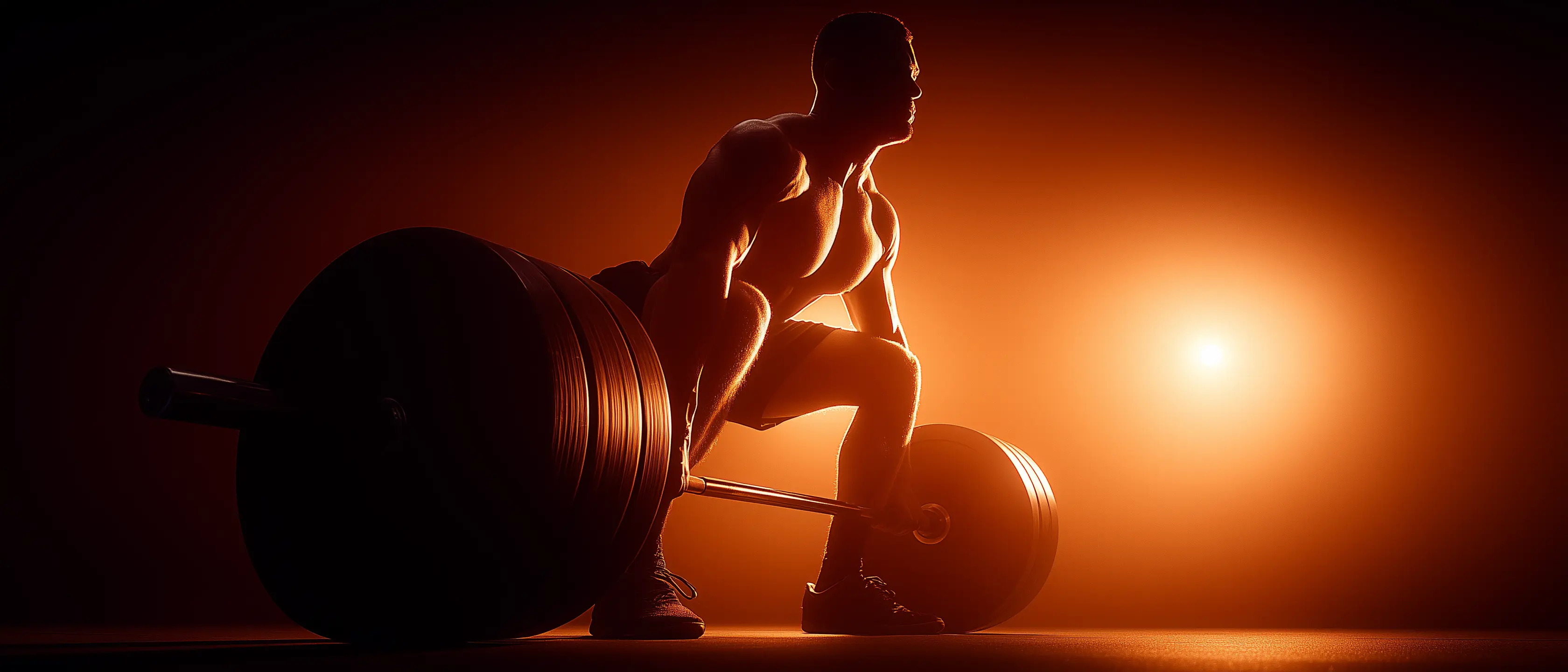
The deadlift is the simplest lift: pick the bar up off the floor, stand up, put it back down. No rack, no bench, no complicated setup.
It’s also where you’ll eventually lift the most weight. A 2x bodyweight deadlift is achievable for most healthy adults with consistent training — that’s 160kg for an 80kg person.
On 5x5, deadlifts are only 1×5 — one set of five reps. This isn’t a mistake. Deadlifts are demanding enough that one heavy set provides all the stimulus you need.
Why Deadlifts Matter
The deadlift trains your entire posterior chain: hamstrings, glutes, spinal erectors, traps, and lats. It also builds grip strength that transfers to every other lift.
More importantly, it trains the picking-things-up pattern. Every time you lift a heavy box, grab luggage off a carousel, or pick up your kids, you’re deadlifting. A strong deadlift makes daily life easier and protects your back.
People fear deadlifts because of back injury concerns. Here’s the reality: deadlifts with proper form strengthen your back. A 2015 study in the Journal of Strength and Conditioning Research found that deadlift training reduced lower back pain in individuals with mild to moderate disc degeneration.
The lift that people avoid to “protect their back” is actually one of the best things for back health. Learn how the deadlift fits alongside the other barbell movements in our exercise guide.
Conventional Deadlift Setup
We’re covering conventional deadlift here — feet hip-width apart, hands outside the legs. Sumo deadlift (wide stance, narrow grip) is a valid alternative if your build suits it better.
Stance
Stand with feet hip-width apart. Not shoulder-width — closer than that. Your toes can point straight ahead or slightly out (up to 15 degrees).
The bar should be over your mid-foot — not against your shins, not inches away. Look down: the bar should split your foot in half.
Hinge and Grip
Without moving the bar, hinge at your hips and bend your knees until you can grip it. Hands should be just outside your legs — close enough that your arms hang straight down.
Grip options:
- Double overhand: Both palms facing you. Use this until grip fails.
- Mixed grip: One palm facing you, one facing away. Stronger grip, slight asymmetry.
- Hook grip: Thumb under fingers, both palms facing you. Painful but very strong.
Start with double overhand. Switch to mixed grip when grip becomes limiting.
Setting Your Back
This is where most people fail. Before you lift, you need a flat back — specifically, a flat lower back.
Cues that help:
- “Chest up” — creates extension in your thoracic spine
- “Long spine” — elongates rather than rounds
- “Protect your armpits” — engages lats
What you’re looking for: lower back flat or slightly arched (not rounded), upper back tight, shoulder blades over or slightly in front of the bar.
Take a breath and brace before you pull.
The Checklist
Before every rep, verify:
- Bar over mid-foot ✓
- Hands just outside legs ✓
- Hips lower than shoulders but higher than knees ✓
- Back flat, lats engaged ✓
- Arms straight (no bend at elbow) ✓
Pulling the Weight
Initiate the Pull
Push through the floor with your legs while pulling your chest up. Think “leg press the floor away” rather than “yank the bar up.”
The bar should stay in contact with your body. As you rise, it drags up your shins and thighs. Wearing pants or high socks prevents skin scraping.
Hip and Knee Extension
Your knees straighten first, then your hips. If your hips shoot up and your back rounds, the weight is too heavy — or your quads are too weak relative to your posterior chain.
Everything locks out at the same time at the top: knees straight, hips fully extended, shoulders back. Stand tall with the weight.
The Lockout
At the top: stand completely upright. Knees locked, hips pushed forward, shoulders back. No hyperextension — just standing up straight.
A common mistake is leaning back at the top. This doesn’t make the rep count more; it just stresses your lower back unnecessarily.
The Descent
Lower the bar by hinging at your hips, then bending your knees once the bar passes them. This is the exact reverse of the pull.
Don’t just drop the bar and let gravity take it. Control the descent — but don’t turn it into a slow eccentric either. The descent takes about a second.
Reset at the bottom before your next rep.
Common Mistakes
Mistake 1: Rounded Lower Back
The most dangerous deadlift mistake. A rounded lower back puts your spinal discs at risk under load.
Signs: Your lower back looks like a “C” shape instead of flat or slightly arched.
Causes:
- Weight too heavy
- Hamstring tightness
- Poor body awareness
- Weak spinal erectors
Fixes:
- Reduce weight immediately
- Film yourself from the side to check
- Strengthen core with planks
- Work on hamstring flexibility
A slightly rounded upper back under heavy loads is acceptable. Lower back rounding is not.
Mistake 2: Bar Drifting Forward
If the bar drifts away from your body, you lose leverage and stress your lower back.
Signs: The bar doesn’t stay against your legs; it loops forward during the pull.
Causes:
- Not engaging lats
- Starting with bar too far from shins
- Rising hips-first
Fixes:
- Cue “protect your armpits” to engage lats
- Start with bar over mid-foot (close to shins)
- Think “leg press” to keep the pull leg-dominant initially
Mistake 3: Hitching
Hitching is when you rest the bar on your thighs and bounce it up instead of pulling in one smooth motion.
Signs: The bar stops moving mid-thigh, then you jerk your hips forward to finish the lift.
Causes: Weight too heavy for your current strength
Fixes: Reduce weight. The deadlift should be one continuous pull from floor to lockout.
Mistake 4: Jerking the Bar
Yanking the bar off the floor with bent arms risks bicep tears and reduces lifting efficiency.
Signs: Your arms bend at the start of the pull; you “jerk” the bar.
Causes: Trying to lift too fast, treating it like a power clean
Fixes:
- “Take the slack out” before you pull — apply gradual pressure until the bar is about to leave the ground
- Keep arms completely straight throughout
- Build tension progressively, don’t yank
Mistake 5: Hips Rising First
If your hips shoot up at the start, you’re turning the deadlift into a stiff-leg deadlift with extra steps.
Signs: Your butt rises but the bar hasn’t moved; you end up pulling with a nearly horizontal back.
Causes:
- Starting with hips too low
- Weak quads
- Pulling hips-dominant instead of legs-dominant initially
Fixes:
- Start with hips at proper height (higher than knees, lower than shoulders)
- Cue “leg press the floor” to keep legs engaged
- Strengthen quads if this is a consistent pattern
Only One Set?
Yes, deadlifts are programmed as 1×5 on 5x5. This seems strange compared to 5×5 for other lifts, but there’s good reasoning.
Deadlifts are uniquely demanding on your central nervous system and spinal erectors. Multiple heavy sets of deadlifts create more fatigue than you can recover from by your next workout.
One set of five at a challenging weight provides sufficient stimulus for strength gains. You’ll progress 5kg per successful workout — faster than any other lift.
If 1×5 feels like not enough work, trust the process. Your deadlift will climb faster than your other lifts, and you’ll appreciate not being destroyed for the rest of the week.
Warm-Up Protocol
Even with only one work set, you need warm-up sets.
Example for 100kg work set:
- 60kg × 5 reps
- 80kg × 3 reps
- 90kg × 1 rep
- 100kg × 5 (work set)
These aren’t exhausting you — they’re preparing your body for the heavy weight. Skip the warm-up and risk pulling a cold muscle.
Grip Training
Double overhand grip will fail before your back and legs do. This is normal and not a reason to immediately switch to mixed grip.
How to strengthen your grip:
- Use double overhand as long as possible
- Add chalk — it makes a huge difference
- Do dead hangs from a pull-up bar (aim for 60+ seconds)
- Only switch to mixed grip when double overhand fails
A strong grip transfers to every other exercise and to daily life. Don’t rely on straps as a beginner.
Progression
Add 5kg every successful Workout B. Deadlifts progress faster than other lifts because:
- The posterior chain can handle heavier loads
- You deadlift from the floor (no stretch reflex, so you’re building pure strength)
- Less frequency means better recovery between sessions
It’s not unusual for your deadlift to outpace your squat by 20-30kg within a few months.
Building Your Deadlift
The deadlift responds to patient, consistent work. Show up every Workout B, nail your form, and add your 5kg when you earn it.
Film yourself regularly — ideally every session. Back rounding is hard to feel but easy to see on video.
In six months, you’ll be pulling weights that seem impossible now. And your back will be stronger for it. For technique breakdowns of all five barbell lifts, visit the complete exercise guide.
Track your deadlift progress automatically:
Track your 5x5 progress automatically
Built-in plate calculator, rest timer, and auto-progression. Free for iOS & Android.
Helping lifters get stronger with the simplest program that works. No BS, just barbells.