Ankle and hip mobility for deeper squats
Practical mobility drills to improve squat depth. Fix ankle dorsiflexion and hip flexion limitations with a daily routine that takes 5-10 minutes.
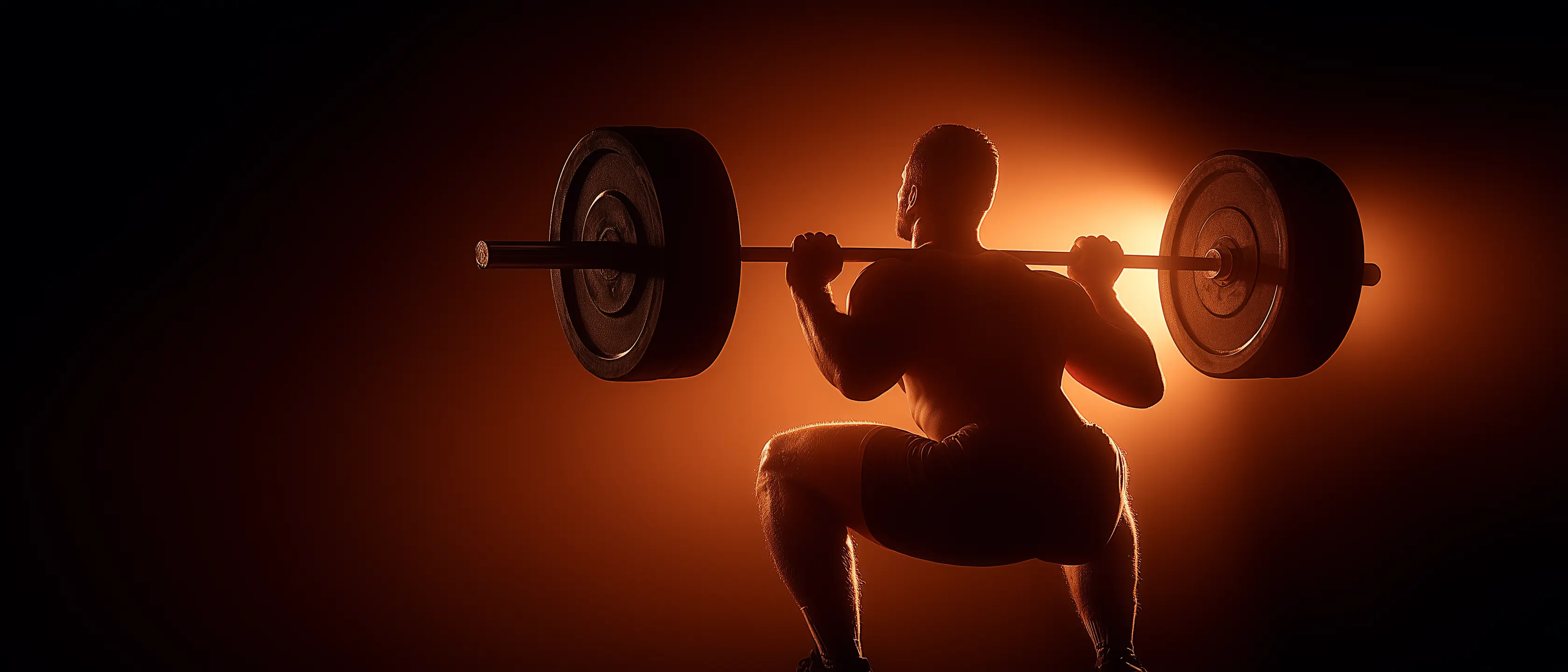
You know you should be squatting deeper. Your strength coach, every lifting forum, and the voice in your head all say the same thing: hit depth. But every time you try, something stops you. Your heels lift. Your lower back rounds. Your knees cave in. It feels like your body simply won’t go there.
It will. You almost certainly have the skeletal structure for a full-depth squat. What you likely lack is the mobility to access it under load. Since squats are central to the 5x5 progression system, improving your depth directly improves your ability to progress — and a biomechanical review of squat depth found that deep squats, done with good technique, are both safe and effective for building strength. And unlike strength, which takes months to build, usable squat mobility can improve meaningfully in weeks with the right daily work.
The two mobility bottlenecks
Most squat mobility problems trace back to two joints: ankles and hips. Your knees, thoracic spine, and core stability play roles too, but the ankles and hips are where limitations show up first and most often.
Ankle dorsiflexion: why your heels rise
Dorsiflexion is the ability to bring your shin forward over your toes - the movement your ankle makes as you descend into a squat. A study that artificially restricted ankle dorsiflexion during squats found it shifted the movement toward more forward trunk lean and altered knee mechanics — exactly the compensations lifters see. Limited dorsiflexion forces your heels to lift, your torso to pitch forward, and your lower back to round to keep balance.
Most adults who sit at desks all day have restricted ankle dorsiflexion. Years of wearing shoes with elevated heels and spending hours in a limited range of motion gradually stiffens the calf muscles and ankle joint capsule.
You need roughly 35-40 degrees of ankle dorsiflexion for a full-depth squat. Many desk workers have 15-25 degrees. That gap is the difference between a smooth, deep squat and one that falls apart halfway down.
Hip flexion: why you can’t sit between your legs
Hip flexion - the ability to bring your thigh toward your torso - determines how far you can descend before your pelvis tucks under (the dreaded “butt wink”). Tight hip flexors, adductors, and external rotators all contribute to limited hip mobility.
Unlike ankle mobility, which is relatively straightforward, hip mobility is influenced by bone structure. The depth and angle of your hip sockets (acetabulum) and the shape of your femoral head vary significantly between people. This is why some people can drop into a deep squat with zero warmup while others struggle even with good mobility.
You can’t change your bone structure. But you can almost certainly improve the soft tissue restrictions that sit on top of it - and for most lifters, soft tissue is the primary limiter, not anatomy.
Testing your mobility
Before you start drilling mobility work, figure out where your actual limitations are. You might assume your hips are tight when your ankles are the real bottleneck, or vice versa.
The knee-to-wall test (ankles)
This is the simplest and most reliable test for ankle dorsiflexion.
- Stand facing a wall with one foot about 10cm (4 inches) from the wall
- Keep your heel flat on the ground
- Push your knee forward toward the wall
- If your knee touches the wall with your heel down, move your foot back slightly and repeat
- The maximum distance where your knee still touches the wall with your heel flat is your dorsiflexion measurement
Results:
- 12+ cm: Good ankle mobility. Probably not your limiting factor
- 8-12 cm: Moderate limitation. Will benefit from daily work
- Less than 8 cm: Significant restriction. This is likely affecting your squat depth considerably
Test both sides. Asymmetry is common and worth addressing.
The deep squat hold test (hips and overall)
- Stand with feet shoulder-width apart, toes turned out 15-30 degrees
- Squat as deep as you can while keeping heels flat and chest up
- Hold the bottom position
What to observe:
- Heels lifting: Ankle dorsiflexion is limited
- Lower back rounding (butt wink): Hip flexion limitation or hamstring tightness
- Knees collapsing inward: Weak or tight hip abductors/external rotators
- Chest dropping forward: Thoracic extension limitation or simply a balance compensation for ankle restriction
- Can’t get to parallel: Some combination of the above
Most people have multiple limitations. That’s normal. Address them systematically rather than trying to fix everything at once.
Ankle mobility drills
Do these daily. 2-3 minutes per ankle is sufficient. Consistency beats duration - five minutes every day produces better results than twenty minutes twice a week.
Weighted ankle stretch
This is the highest-return ankle drill. It applies sustained pressure to the ankle joint in dorsiflexion.
- Get into a half-kneeling position with your front foot flat on the ground
- Place a weight plate, kettlebell, or dumbbell on your front knee
- Push your knee forward over your toes, keeping your heel flat
- Hold for 30-45 seconds at the end range where you feel a deep stretch in the front of the ankle and the calf
- Rock gently in and out of the end range
- 3 sets per side
The added weight helps push through the stiffness. Start light (5-10kg) and increase as your range improves.
Banded ankle mobilization
A resistance band creates a posterior glide of the talus (ankle bone), which directly improves the joint mechanics of dorsiflexion.
- Anchor a resistance band at ankle height (to a rack or heavy object)
- Step into the band so it wraps around the front of your ankle, just below the shin
- Step away from the anchor point to create tension (the band should pull your ankle backward)
- With the band pulling your ankle back, drive your knee forward over your toes
- Rock in and out of dorsiflexion for 15-20 reps per side
- 2-3 sets per side
This drill often produces immediate temporary improvements in range. Over time, the gains become permanent.
Standing calf stretch
Simple and effective. Tight calves are a primary contributor to restricted dorsiflexion.
- Stand on a step or platform with your heels hanging off the edge
- Lower one heel below the platform level, keeping the leg straight
- Hold for 30-45 seconds
- Repeat with a slightly bent knee (this targets the soleus, a deeper calf muscle that limits dorsiflexion more than the gastrocnemius)
- 2-3 sets per side
Do the bent-knee version even if the straight-leg version feels easy. The soleus sits closer to the ankle joint and is a more common dorsiflexion limiter in squatters.
Hip mobility drills
Hip mobility work should target flexion (getting deeper), external rotation (keeping knees out), and adductor flexibility (allowing a wider stance if needed).
Deep goblet squat hold
The single best hip mobility drill for squatters is simply sitting in the bottom of a squat. Adding a light weight helps counterbalance and allows you to sit deeper.
- Hold a light kettlebell or dumbbell at your chest (10-16kg is usually plenty)
- Squat as deep as you comfortably can with your heels flat
- At the bottom, use your elbows to gently push your knees outward
- Hold for 30-60 seconds
- 2-3 sets
The weight acts as a counterbalance that lets you sit more upright without falling backward. The elbow pressure opens your hips. Over time, you’ll be able to sit deeper and more comfortably.
Do this before every squat session. It doubles as the best possible squat-specific warmup.
90/90 stretch
This targets both internal and external rotation of the hips simultaneously.
- Sit on the floor with one leg in front (shin parallel to your chest, knee bent 90 degrees) and one leg to the side (also bent 90 degrees, behind you)
- Keep your chest tall and square
- Lean gently toward your front shin, feeling a stretch in the front hip
- Hold for 30-45 seconds
- Rotate to the other side
- 2-3 sets per side
If you can’t get into this position comfortably, place a cushion under the hip of your front leg. The goal is a controlled stretch, not forcing yourself into pain.
Pigeon stretch
An excellent hip flexor and external rotator stretch that specifically targets the range needed for squats.
- Start in a push-up position
- Bring your right knee forward and place it behind your right wrist, with your shin angled across your body
- Lower your left leg to the ground behind you, keeping it straight
- Sink your hips toward the floor
- Hold for 45-60 seconds per side
- For more intensity, fold forward over your front shin
If this position is too intense, do it on an elevated surface (a bench or bed) where you can control how much weight goes into the stretch.
Hip circles (controlled articular rotations)
CARs improve joint health by actively moving the hip through its full range of motion under muscular control.
- Stand on one leg (hold a wall for balance)
- Lift your knee as high as possible in front of you
- Slowly rotate it out to the side, keeping it high
- Continue the rotation behind you, lowering the leg
- Reverse the direction
- 5 circles each direction, each side
These should be slow and controlled. You’re exploring range of motion, not swinging your leg. Make each circle as large as possible while maintaining control.
The often-overlooked piece: thoracic mobility
Your upper back (thoracic spine) plays a bigger role in squat depth than most people realize. If your thoracic spine can’t extend properly, your chest drops forward as you descend. This shifts your center of gravity, forces your lower back to compensate, and limits how deep you can go safely.
Foam roller thoracic extensions
- Place a foam roller perpendicular to your spine at mid-back level
- Support your head with your hands
- Extend backward over the roller, letting your upper back arch
- Hold for 2-3 seconds at the end range
- Move the roller up slightly and repeat
- Work from mid-back to upper back, 10-15 extensions total
Wall slides
- Stand with your back flat against a wall, feet about 30cm from the wall
- Press your head, upper back, and hips against the wall
- Place your arms against the wall in a “goalpost” position (elbows at 90 degrees)
- Slowly slide your arms up the wall, keeping everything in contact
- Slide back down
- 10-15 reps
If you can’t keep your arms and back against the wall simultaneously, that’s your answer for why your chest drops in the squat.
Short-term fixes while you build mobility
Mobility improvements take weeks. Training shouldn’t wait. Here are immediate solutions.
Heel elevation
Placing your heels on small weight plates (2.5-5kg plates work well) or a thin board during squats instantly compensates for limited ankle dorsiflexion. Your shins can travel forward more easily, allowing you to stay upright and descend deeper.
This is not cheating. It’s a legitimate modification used by Olympic weightlifters worldwide. Use it while you work on ankle mobility over the coming weeks.
Squat shoes
Weightlifting shoes have a built-in elevated heel (typically 0.75-1.0 inches) that provides the same benefit as plates but with better stability. If you plan to squat seriously for years, a pair of squat shoes is one of the best investments you can make. See the lifting shoe guide for recommendations.
Stance adjustments
Before assuming you need more mobility, experiment with your stance:
- Wider stance: Often allows deeper squats because the femur can externally rotate more, creating space in the hip joint
- More toe-out: Turning your toes out 30-45 degrees (instead of 15-20) often eliminates hip pinching at depth
- Narrower stance: Some people with long femurs actually squat deeper with a narrower stance
There’s no universally correct squat stance. Your ideal stance depends on your proportions and hip anatomy. Try different widths and angles during warmup sets to find what lets you hit depth most comfortably.
Your pre-squat mobility routine
Here’s a 5-10 minute routine to do before every squat session. This isn’t a substitute for daily mobility work - it’s a squat-specific warmup that prepares your joints for the range of motion you’re about to demand. Keep the pre-lift work dynamic and the static holds short: a meta-analysis of pre-exercise static stretching found that long static holds before training can temporarily reduce maximal force output. Save your longest stretches for after the session.
- Ankle circles: 10 each direction, each ankle (30 seconds)
- Banded ankle mobilization: 15 reps each side (2 minutes)
- Hip circles (CARs): 5 each direction, each hip (2 minutes)
- Deep goblet squat hold: 2 holds of 30-45 seconds (2 minutes)
- Foam roller thoracic extensions: 10 reps (1 minute)
- Bodyweight squats: 10-15 slow reps, focusing on depth and control (1 minute)
Then proceed to your warmup sets with the barbell. Your joints will be primed for full range of motion and your first working set will feel noticeably better.
When it’s not mobility
Sometimes the limitation isn’t mobility at all. Two common scenarios:
Core stability
Some lifters have the range of motion for a deep squat when unloaded but fall apart under a barbell. This is a stability problem, not a mobility problem. Their core can’t maintain position against the load.
Signs: You can hit a deep bodyweight squat but your lower back rounds or chest drops with a barbell. Fix this with paused squats at lighter weights, front squats (which demand more upright torso position), and targeted core work.
Fear and unfamiliarity
If you’ve never squatted deep, your body may resist the position simply because it’s unfamiliar. Your nervous system tightens up as a protective mechanism. This resolves with progressive exposure - gradually squatting deeper over sessions with manageable weights.
Box squats with progressively lower box heights are excellent for building confidence in the bottom position.
The bottom line
Squat mobility isn’t a gift - it’s a skill you build. Limited ankle dorsiflexion and hip flexion are the two most common restrictions, and both respond well to consistent daily work.
Test your limitations. Spend 5-10 minutes daily on targeted drills. Use heel elevation or squat shoes as a bridge while your mobility catches up. Within 4-8 weeks, you’ll be hitting depths you didn’t think your body could reach.
Deeper squats mean better strength development, and better strength development means faster progress on the bar:
Track your 5x5 progress automatically
Built-in plate calculator, rest timer, and auto-progression. Free for iOS & Android.
Frequently asked questions
How long does it take to improve ankle mobility?
Most people notice meaningful improvement within 4-8 weeks of consistent daily work. Ankle dorsiflexion responds well to daily stretching and mobilization because the limitations are often tissue stiffness rather than structural. Spending 2-3 minutes per ankle, every day, is more effective than 15 minutes twice a week.
Should I use squat shoes or fix my mobility?
Both. Squat shoes (with a raised heel) immediately compensate for limited ankle dorsiflexion, letting you squat deeper right now. But they don't fix the underlying restriction. Use squat shoes to train effectively today while working on ankle mobility over time. Think of them as a bridge, not a permanent crutch.
Can everyone squat to full depth?
Most people can reach parallel or below with adequate mobility work. However, individual anatomy - hip socket depth, femur length, and tibial proportions - affects exactly how deep you can go and what stance width feels best. If your mobility is good but depth is still limited, experiment with stance width and toe angle before assuming it's a structural limitation.
Is it better to stretch before or after squatting?
Do dynamic mobility drills before squatting (ankle circles, hip openers, bodyweight squats) and static stretching after. Pre-squat mobility work prepares your joints for the range of motion you need. Static stretching before heavy lifting can temporarily reduce force production, so save longer holds for after your session or on rest days.
My hips hurt at the bottom of the squat. Is that a mobility issue?
It could be mobility, but it could also be stance width, toe angle, or hip anatomy. Many people find that widening their stance and pointing their toes out more (30-45 degrees) eliminates hip pinching at depth. If adjusting your stance doesn't help and the pain persists, read the full guide on hip pain during squats for more targeted solutions.
Writes the Lift5x5 training blog. Over a decade under the bar running 5x5-style programs — practical strength advice with no BS, just barbells.
More about Erik →