How to increase your squat strength
Build a stronger squat with proven form fixes, programming strategies, and accessory work. Fix weak points, break plateaus, and squat with confidence.
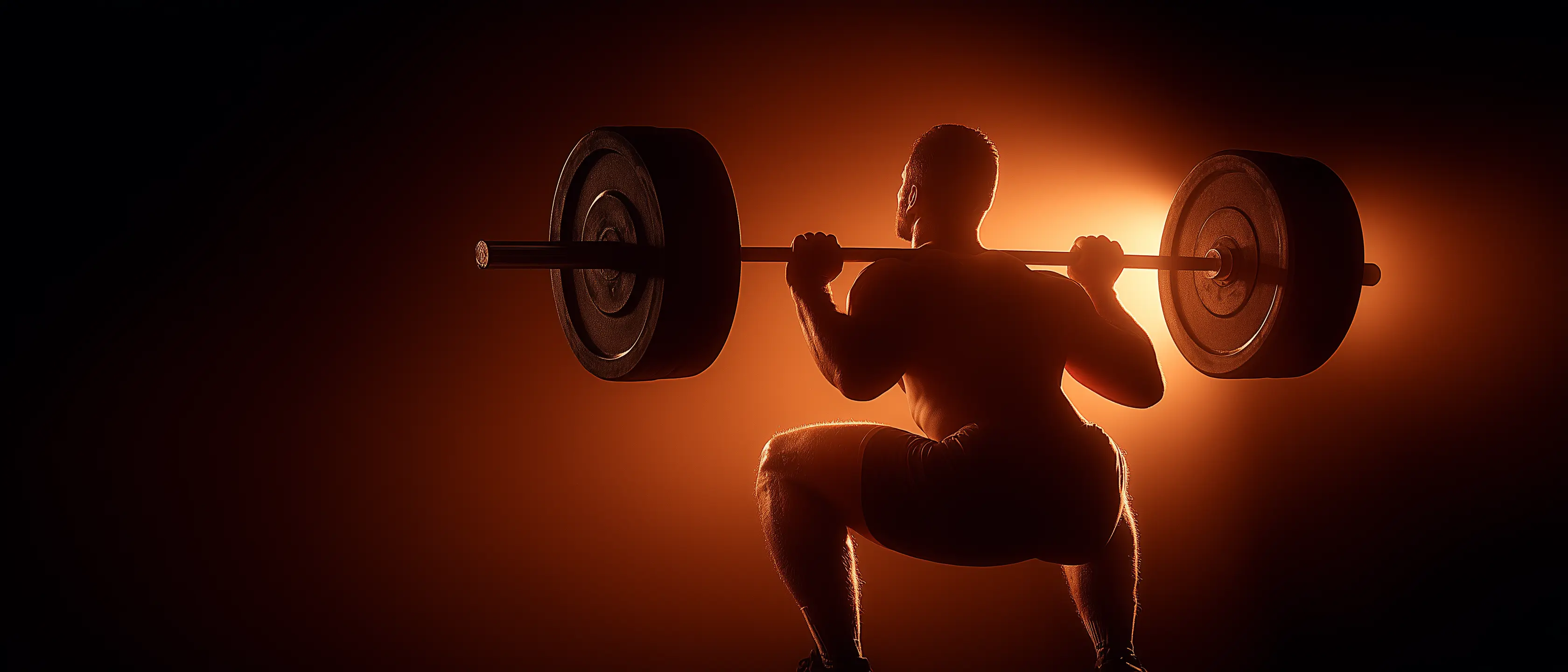
The squat is the most important of the five exercises in 5x5. You do it every workout, three times per week. When your squat goes up, everything goes up - your deadlift improves, your core gets stronger, and your overall training capacity grows.
But squats are also the lift that intimidates people most. A heavy bar on your back, lowering yourself into a deep position, and trusting your legs to bring you back up requires physical and mental strength.
This guide covers how to build both.
Form fixes that immediately add weight
Small technique improvements create large strength gains. Before you change your programming or add accessories, audit these fundamentals.
Breathing and bracing
If you fix one thing about your squat, make it this.
The Valsalva maneuver is the breathing technique used in every heavy barbell movement:
- Take a deep breath into your belly (not your chest)
- Brace your entire core - abs, obliques, lower back - as if preparing to take a punch
- Hold that brace through the entire rep
- Exhale at the top, reset, and repeat
Proper bracing creates intra-abdominal pressure that stabilizes your spine like a natural weight belt. Without it, your torso collapses under heavy weight, your back rounds, and you lose force transfer from legs to bar.
A 2006 study in the Journal of Strength and Conditioning Research found that intra-abdominal pressure during squats correlated directly with load lifted. Lifters who braced effectively could handle significantly more weight than those who didn’t, independent of actual leg strength.
Practice bracing with lighter weights. By the time the weight gets heavy, it should be automatic.
Depth
Your hip crease must drop below the top of your knee. This is “below parallel” and it’s the standard for a proper squat.
Cutting depth short doesn’t just reduce the exercise’s effectiveness - it actually limits your strength development. At full depth, your hamstrings wrap around your knee joint, creating a “bounce” out of the hole. Stop high and you lose this elastic contribution.
If depth is your issue, read our complete guide on squat depth. The fixes are usually ankle mobility, hip mobility, or stance width - not flexibility.
Bar position
Where the bar sits affects your mechanics significantly. High bar and low bar squats use different muscle emphasis and allow different loads.
High bar (on your traps): More upright torso, more quad-dominant, requires good ankle mobility. Most people learn to squat high bar.
Low bar (across rear deltoids): More forward lean, more hip-dominant, typically allows 5-10% more weight. Requires shoulder mobility to hold the position.
Switching from high bar to low bar can add 5-10kg to your squat immediately because it shortens the moment arm and uses more hip musculature. But it’s a different movement pattern that takes time to learn.
Our high bar vs low bar comparison covers the trade-offs in detail.
Stance width
Your optimal stance width depends on your hip anatomy. Some people squat best with a narrow stance, others wide. There’s no universal “correct” width.
The test: squat with different stance widths and see where you feel strongest and most comfortable hitting depth. Start at shoulder width and experiment outward.
Signs your stance is wrong:
- Can’t hit depth without excessive forward lean (try wider)
- Knees cave inward (try wider or point toes out more)
- Hip pain at the bottom (try narrower or adjust toe angle)
- Feeling off-balance (try the opposite direction from what you’ve been doing)
Identify your weak point
Where and how you fail a squat tells you exactly what to train.
Failing out of the hole
What it looks like: You descend fine, reach the bottom, and can’t stand back up. The bar stops moving in the lowest portion of the lift.
Weak muscles: Quads, glutes
The bottom of the squat requires your quads and glutes to overcome inertia and reverse the bar’s direction. If they’re not strong enough, you get stuck.
Fixes:
- Pause squats: Descend, hold the bottom position for 2-3 seconds, then drive up. Use 75-80% of your working weight, 3 sets of 3-5 reps. This builds strength at the exact point where you’re weakest.
- Front squats: Force an upright torso and overload the quads. 3 sets of 5 with moderate weight after your main squats.
- Leg press: If available, 3 sets of 8-10 as a quad-focused accessory. Not a replacement for squats, but useful supplementary volume.
Good-morning squat
What it looks like: Your hips rise faster than your shoulders as you drive out of the hole. Your torso pitches forward and the squat turns into a hip hinge. Your lower back takes the load.
Weak muscles: Quads, core (relative to posterior chain)
This is the most common squat problem after beginners move past the light weight phase. Your posterior chain (hamstrings, glutes, lower back) is strong enough but your quads and core can’t keep up.
Fixes:
- Front squats: Force your quads to do more work and punish forward lean (the bar will roll off your shoulders if you lean too far). 3 sets of 5.
- Tempo squats: 3-4 second descent, controlled ascent. This eliminates momentum and exposes the weakness. Use 70-75% of working weight.
- Core work: Planks, pallof presses, or ab wheel rollouts. 3 sets of 30-60 seconds or 10-15 reps. A strong core keeps your torso upright under load.
Stalling at mid-range
What it looks like: You get out of the hole but the bar slows or stops about halfway up.
Weak muscles: Quads (specifically the vastus medialis), glutes
Fixes:
- Pin squats: Set the safety bars at your sticking point height. Start each rep from the pins (dead stop) and stand up. 3 sets of 3-5 reps. Builds strength at the exact stalling point.
- Walking lunges: Build single-leg strength and expose bilateral imbalances. 3 sets of 8-10 per leg.
- Leg extensions: Direct quad isolation if available. 3 sets of 10-12 as a finishing exercise.
Programming for squat strength
Frequency is already optimal
On 5x5, you squat three times per week. Research consistently supports this frequency for novice lifters.
A 2015 study in the Journal of Strength and Conditioning Research by Schoenfeld et al. found that squatting 3x per week produced greater strength gains than 1x per week when total volume was equated. You’re already in the optimal range.
Don’t add a fourth squat day. Instead, optimize the three sessions you already have.
Progressive overload is the driver
Adding 2.5kg per squat session on 5x5 means:
- 7.5kg per week
- 30kg per month
- 90kg in three months
This rate of progression only works for beginners, and it works because novice adaptation is powerful. Respect the process. Don’t try to jump ahead - you’ll stall sooner with worse technique.
Read our full explanation in progressive overload: the key to getting stronger.
When progression stalls
Follow the standard 5x5 protocol:
- Fail to complete 5x5: Repeat the same weight next session
- Fail three times at the same weight: Deload 10% and work back up
- Stall again at the same weight after deload: Try the strategies in our plateau guide
Most beginners get 3-6 months of linear squat progression before their first stall. After that, it’s common to deload and push through 2-3 more cycles before needing intermediate programming.
Intermediate options
When linear session-to-session progression is exhausted, weekly progression takes over:
- Madcow 5x5: Ramps up to one heavy set of 5 each session, adds weight weekly
- Texas Method: Volume day, recovery day, intensity day structure with weekly PRs
These aren’t better programs - they’re the next step when beginner programs stop working.
Accessory work for squats
Keep accessories minimal. Your squat sessions on 5x5 are already demanding. Add 1-2 accessories after your main work, not 5-6.
High carryover
Front squats. The best squat accessory, period. Builds quad strength, core stability, and forces proper positioning. If you can front squat 80% of your back squat, your weak point isn’t your quads.
Pause squats. Take your working weight, reduce it by 20-25%, and add a 2-3 second pause at the bottom. Eliminates the stretch reflex and builds raw strength out of the hole.
Moderate carryover
Walking lunges. Single-leg strength and balance. Exposes and fixes bilateral imbalances. 3 sets of 8-10 per leg with dumbbells.
Leg press. Pure quad volume without the systemic fatigue of barbell squats. Useful when your legs can handle more work but your back and core are fatigued. 3 sets of 8-10.
Romanian deadlifts (RDLs). Strengthen the posterior chain (hamstrings, glutes) which supports the squat descent and ascent. 3 sets of 8-10.
Supplementary
Leg extensions. Direct quad isolation. Useful as a finishing exercise when quads are the clear weak point. 2-3 sets of 10-15.
Glute bridges / hip thrusts. Glute isolation for lifters whose glutes are underfiring during squats. 3 sets of 10-12.
Core work. Planks, pallof presses, ab wheel. Strong core = stable torso under load. 2-3 sets at the end of a session.
Mobility for better squats
Limited mobility forces compensations that limit strength. If you can’t hit depth without your back rounding or heels rising, no amount of strength work fixes the underlying problem.
Ankle dorsiflexion
Tight ankles force excessive forward lean or prevent proper depth. Test: kneel with your toe 4 inches from a wall. Can your knee touch the wall without your heel lifting? If not, your ankles are limiting.
Fix: Wall ankle stretches, 30 seconds per side, daily. Alternatively, squat shoes with a raised heel buy you immediate dorsiflexion.
Hip flexors
Tight hip flexors pull your pelvis into anterior tilt and restrict depth. Common in people who sit all day.
Fix: Half-kneeling hip flexor stretch, 30 seconds per side. Couch stretch for deeper work. Do these before every squat session.
Hip external rotation
Limited external rotation causes knee cave and restricts your ability to push your knees out over your toes.
Fix: 90/90 stretch, pigeon pose, or deep goblet squat holds (sit at the bottom with a light weight and use your elbows to push your knees out). 60 seconds per position.
Do mobility work daily if it’s limiting your squat. Progress is slow but cumulative.
The mental side of heavy squats
Nobody talks about this enough. Heavy squats are psychologically demanding in a way other lifts aren’t.
On a bench press, you can roll the bar off your chest. On a deadlift, you can just drop it. On a squat, you have a heavy bar on your back and you’re about to lower yourself into a deep position. Your body’s survival instinct says this is a bad idea.
Building confidence
Use safety bars. Set the power rack safeties at the right height and practice failing on purpose with a light weight. Once you know you can bail safely, the fear diminishes significantly.
Film yourself. Watching your own squat on video gives you objective feedback. Often, a weight that felt like a near-death experience looks completely smooth on camera.
Approach heavy sets with a routine. Same walk-out, same breath, same brace, every time. Routines reduce anxiety because your body knows what comes next.
Don’t psyche yourself out during warm-ups. If your warm-up set at 80% felt heavy, that doesn’t predict your work set. Warm-up fatigue is real but it dissipates. Many lifters have their best work sets after “bad” warm-ups.
Dealing with fear of failure
Everyone fails squats eventually. It’s part of the program. Failing a squat in a power rack is safe and unremarkable. The bar lands on the safeties, you duck out, and you set up for the next attempt.
Fearing failure leads to cutting depth short, which leads to worse performance, which reinforces the fear. Break the cycle by failing deliberately during a light session. Prove to yourself it’s not a big deal.
Belt usage
A lifting belt amplifies your brace by giving your abs something to push against, increasing intra-abdominal pressure. It doesn’t protect your back - it enhances your ability to protect your own back.
When to start using a belt
- After you can squat 1-1.5x your bodyweight with solid bracing technique
- When the brace itself is limiting your performance, not your leg strength
- When you understand how to brace without a belt
When not to use a belt
- On warm-up sets (brace without assistance to keep the skill sharp)
- On sets below 80% of your max
- If you’re using the belt as a substitute for proper bracing
A belt can add 5-10% to your squat by improving core stability. But belt-dependent squatting without the underlying bracing skill creates a weak point that catches up with you.
Realistic progress benchmarks
These are rough targets for consistent 5x5 training with adequate nutrition and sleep.
3 months
- Starting from empty bar: ~90-110kg squat
- Bodyweight squat for many men in this range
- Form should be solid and consistent
6 months
- 120-150kg range for most men
- 60-80kg range for most women
- First significant plateaus and deloads
12 months
- 140-180kg for dedicated male lifters
- 70-100kg for dedicated female lifters
- Likely transitioned to intermediate programming
These numbers assume consistent training (3x/week), reasonable nutrition (adequate protein and calories), proper sleep (7-9 hours), and average genetics. Your numbers may be higher or lower. What matters is that they’re consistently going up.
For the complete progression timeline, see our 5x5 results timeline.
Squat more, squat better
The squat rewards consistency more than any other lift. You train it three times per week on 5x5. Every session is a chance to practice, to get stronger, to add weight.
Fix your bracing. Hit proper depth. Identify your weak point and address it with one or two targeted accessories. Handle the mental challenge. And add 2.5kg every time you complete your sets.
There’s no trick to a bigger squat. Just progressive overload, proper technique, and enough patience to let the math work. Master all five lifts and the strength follows.
Track your 5x5 progress automatically
Built-in plate calculator, rest timer, and auto-progression. Free for iOS & Android.
Helping lifters get stronger with the simplest program that works. No BS, just barbells.