Front squat vs back squat for strength
Honest comparison of front and back squats. Biomechanics, muscle activation, mobility demands, and when to use each for your training goals.
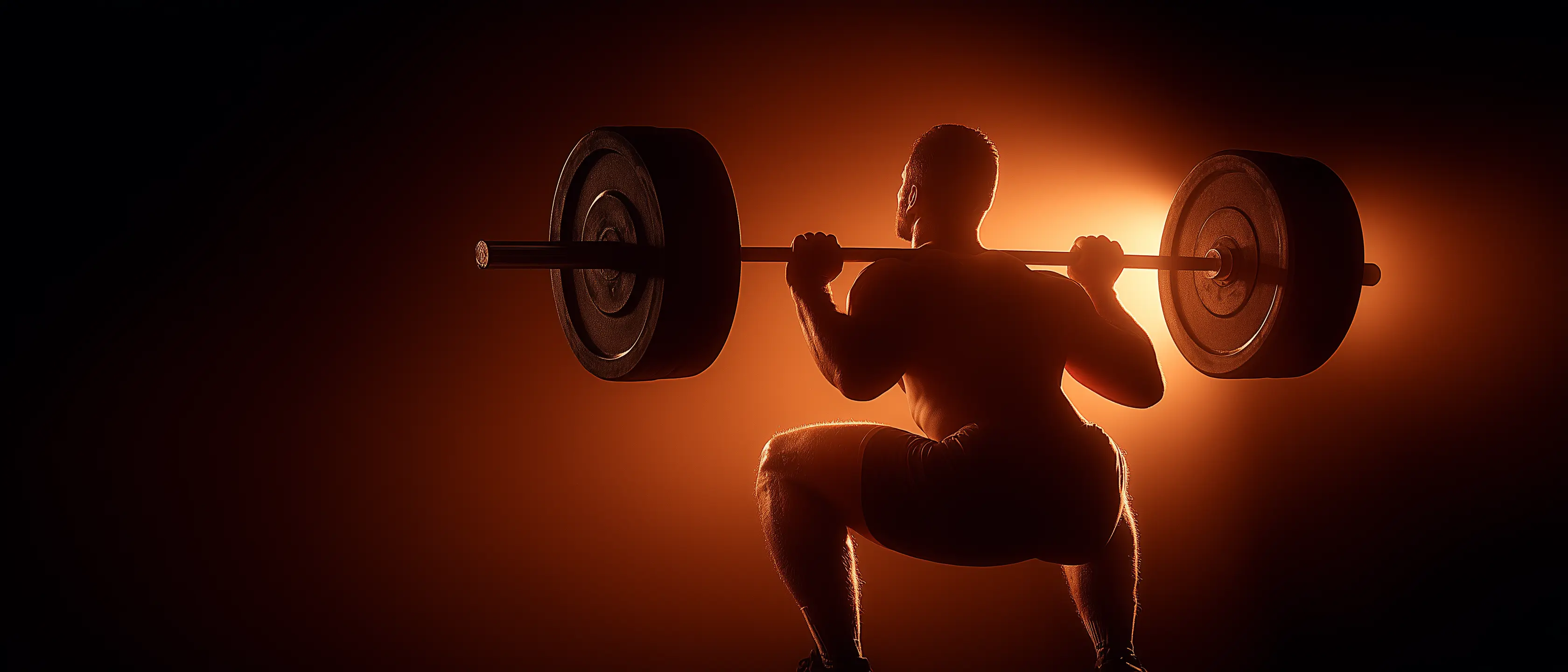
Every serious lifter eventually asks whether they should front squat, back squat, or both. The answer depends on your goals, but the comparison is more nuanced than most people realize.
The back squat is the default squat in nearly every strength program — and one of the five foundational exercises in 5x5 — for good reason. But the front squat isn’t just a lighter version of the same exercise. It changes the biomechanics enough that it trains your body differently and fills gaps the back squat leaves open.
Here’s an honest breakdown of both lifts, when to use each, and how they fit into your training.
The biomechanical differences
The bar position changes everything. Moving the bar from your back to your front shoulders alters your torso angle, joint demands, and muscle emphasis in ways that matter.
Bar position and torso angle
In a back squat (whether high bar or low bar), the bar sits somewhere on your upper back. Your torso leans forward to keep the combined center of mass over your mid-foot. The amount of lean depends on your bar position and proportions, but some forward lean is inevitable.
In a front squat, the bar sits on your front deltoids in a rack position. To keep this bar from rolling off your shoulders, your torso must stay almost vertical. Even a moderate forward lean causes the bar to fall forward. This upright position is non-negotiable.
This single difference - torso angle - cascades into every other difference between the two lifts.
Joint loading patterns
Back squat: More hip flexion, more torso lean, more shear force on the lumbar spine. The hips work through a larger range, and the lower back handles more compressive and shear load to maintain position.
Front squat: More knee flexion, more upright torso, less spinal shear. The knees travel further forward, the hips don’t need to push back as far, and the nearly vertical spine experiences less of the horizontal forces that stress the lower back.
A 2009 study published in the Journal of Strength and Conditioning Research found that front squats produced significantly lower compressive forces on the knee and lower lumbar joint moments compared to back squats at the same relative intensity. The authors concluded that front squats may be advantageous for lifters with knee problems or spinal concerns.
Where the load goes
The back squat distributes load across the posterior chain: glutes, hamstrings, adductors, quads, and spinal erectors all contribute significantly. It’s a full-body squat that emphasizes the hips.
The front squat shifts load anteriorly. The quads become the primary mover because the upright torso requires the knees to drive forward rather than the hips to push back. The glutes and hamstrings still work, but less than in the back squat. The core and upper back work much harder to maintain the upright position and support the rack.
Muscle activation comparison
EMG (electromyography) research gives us measurable data on how each squat works the muscles.
Quadriceps
Studies comparing front and back squats at equivalent relative loads show similar overall quad activation. A 2015 study in the Journal of Sports Sciences found no statistically significant difference in vastus medialis or vastus lateralis activation between front and back squats performed at 70% of each exercise’s respective 1RM.
However, the practical quad demand in front squats feels higher because the quads bear a larger share of the total workload. In a back squat, your posterior chain handles more of the load. In a front squat, your quads handle most of it.
Glutes and hamstrings
Back squats activate the glutes and hamstrings more, especially in low bar position. The hip-dominant movement pattern requires the posterior chain to extend the hips against heavy load.
Front squats still activate the glutes, but the more upright position reduces hamstring involvement. If posterior chain development is your primary goal, back squats are the better choice.
Core and upper back
Here’s where front squats shine. Maintaining an upright torso with a heavy barbell on your front shoulders requires enormous effort from your core, thoracic erectors, and upper back muscles.
Your anterior core must resist spinal flexion (being pulled forward). Your thoracic extensors must fight to keep your upper back upright. Your lats engage to support the rack position. This makes the front squat one of the best “core exercises” that exists - far superior to any plank or crunch.
Back squats certainly require core engagement, but the demand is different: more about resisting lateral forces and maintaining a braced position during hip extension.
Practical differences that matter
Beyond the science, several practical factors influence which squat works better in different situations.
Weight you’ll handle
Most lifters front squat 70-85% of their back squat. An 80kg back squatter might front squat 56-68kg. This ratio is consistent across experience levels and is simply a function of the movement mechanics.
This means the front squat provides less absolute load for your legs and posterior chain. For maximal strength development, less weight is generally less stimulus - which is why the back squat drives faster progress in a program like 5x5.
However, the front squat’s reduced loading is actually a benefit in some contexts: less spinal compression, less systemic fatigue, and less recovery demand. These factors make it a smart accessory that adds training volume without the cost of another heavy back squat session.
The rack position challenge
The front rack position is the biggest barrier to front squatting. Holding the bar across your front delts with your elbows high requires:
- Wrist flexibility: Your wrists need to extend back far enough to get your fingers under the bar.
- Thoracic mobility: Your upper back must extend enough to create a shelf for the bar.
- Lat flexibility: Tight lats pull your elbows down, which drops the bar.
Many lifters cannot comfortably hold a front rack when they first try. This doesn’t mean front squats aren’t for you - it means you need to work on mobility.
Clean grip vs crossed arms
There are two main ways to hold the bar in a front squat:
Clean grip (recommended): Fingers under the bar, elbows high and forward. This is the same position used in Olympic clean catches. It provides the most security and control.
You don’t need a full grip. Two or three fingertips under the bar is enough. The bar rests on your delts - your hands just keep it in place. People who struggle with the clean grip often try to death-grip the bar, which forces the wrists into an impossible position.
Crossed arms: Arms crossed in front, each hand holding the bar on the opposite shoulder. Easier to learn, requires less wrist mobility, and works fine for moderate weights.
The drawback is that the crossed-arm grip provides less stability at heavy loads. The bar can shift or roll, and you have less control if you need to dump the bar. For serious front squatting, learn the clean grip. For occasional front squats as an accessory, crossed arms is fine.
Failing safely
Front squats have a major safety advantage: if you fail, the bar falls forward off your shoulders. You step back. That’s it.
On a back squat, failing means either dumping the bar behind you (which requires practice and confidence) or getting pinned in the hole. This is why safety pins in a squat rack are essential for back squats.
This safety advantage makes front squats ideal for training to failure or for lifters training alone without a spotter.
Mobility requirements
Front squats demand more mobility in several areas. If you’re stiff, the front squat will expose it immediately.
Ankle dorsiflexion
The upright torso of the front squat requires your knees to travel further forward. This demands more ankle dorsiflexion than a back squat. If your heels lift off the ground during front squats, limited ankle mobility is the cause.
Fixes:
- Squat in shoes with a raised heel (weightlifting shoes or plates under your heels as a temporary fix)
- Perform daily ankle stretches: knee-to-wall stretches, 3 sets of 30 seconds per ankle
- Banded ankle mobilization before squatting
Thoracic extension
A rounded upper back in a front squat means the bar rolls off your shoulders. You need enough thoracic extension to keep your chest up and elbows high throughout the entire movement.
Fixes:
- Foam roll your thoracic spine before front squatting
- Thoracic extension over a foam roller: lie with the roller at your mid-back, extend over it with arms overhead
- Front squat holds: unrack the bar and hold the front rack for 10-15 seconds, focusing on elbow height and chest position
Wrist flexibility
For the clean grip specifically, your wrists need to extend enough to get your fingertips under the bar without your elbows dropping.
Fixes:
- Wrist stretches: press the backs of your hands on a table and lean forward gently
- Use a wider grip to reduce wrist extension demand
- Progress from two fingers under the bar to three, then four as mobility improves
- Wrist wraps can provide support during the transition period
When to use each squat
Back squat: your main lift
For 5x5 and any strength-focused program, the back squat is the primary squat. Reasons:
- Heavier loading drives greater strength adaptation across more muscle groups
- More total muscle involved means more overall development
- Simpler to learn and maintain proper positions under fatigue
- Progressive overload is straightforward: add 2.5kg each session
- Program compatibility - 5x5 is designed around the back squat
You squat three times per week on 5x5. Every one of those sessions should be back squats as written in the program. For everything about proper back squat technique, read the complete squat guide.
Front squat: your best accessory
Front squats earn their place as accessory work alongside a back squat program. They fill specific gaps:
- Quad development beyond what back squats provide, especially if you tend to “good morning” your squats
- Core strength that transfers directly to maintaining position during heavy back squats and deadlifts
- Upper back endurance that helps you stay upright as back squats get heavy
- Reduced spinal load so you can add squat volume without proportionally more recovery demand
- Identifying weaknesses - if your front squat is significantly below 70% of your back squat, you likely have a quad or core weakness
Specific situations
Shoulder injury preventing back squats: Front squats remove the shoulder external rotation demand of holding the bar on your back. Many lifters with shoulder impingement can front squat comfortably.
Lower back issues: The reduced spinal shear of front squats may allow pain-free squatting when back squats aggravate the problem. This isn’t a diagnosis or treatment - see a professional - but it’s a common pattern.
Training for Olympic lifting: If cleans or snatches are in your future, front squats train the exact receiving position. They’re essential, not optional.
Returning from injury or deload: Front squats at moderate weight provide an excellent training stimulus with lower recovery cost. A deload week using front squats instead of back squats can maintain the squatting pattern while allowing your spine to recover.
Programming front squats alongside 5x5
If you want to add front squats to your 5x5 training, keep it simple.
Option 1: After back squats
Do your back squat 5x5 as programmed. Then add 3x5 front squats at 60-65% of your back squat. This provides extra quad volume and core work without a separate training day.
Be warned: your front squat weight may need to start lighter than expected. Back squatting 5x5 before front squats means you’re already fatigued.
Option 2: On a separate day
If you train more than three days per week, add a light front squat session on a non-5x5 day. 4x6 at moderate weight builds the movement pattern without heavy systemic fatigue.
Option 3: Temporary substitution
Swapping front squats for back squats for 2-4 weeks can be a productive change of pace, especially if you’ve been grinding on heavy back squats and need a mental and physical reset. You’ll use less weight, but the change in stimulus can break up monotony and expose weaknesses.
Return to back squats after the block and you’ll often find that your core and quad strength have improved, making your back squat feel more solid.
How to progress front squats
Use the same principles as back squats: complete all prescribed reps with good form, then add weight. Because front squats are lighter, 2.5kg jumps represent a larger percentage, so progression will be slower. This is normal.
Keep your front squat as a secondary priority. If front squat fatigue compromises your back squat performance, reduce front squat volume or weight. The back squat is the main lift. Front squats serve the back squat, not the other way around.
The verdict
The back squat is your primary strength builder. It loads more weight, involves more muscle, and drives faster progress. There’s a reason every proven strength program puts the back squat at the center.
The front squat is the best squat accessory you can do. It builds quad strength, core rigidity, and upper back endurance that directly improve your back squat. It’s also easier on your spine and simpler to bail from.
You don’t need to choose one or the other. Back squat for strength. Front squat for support. Together they build a more complete, more resilient squatter.
Learn proper technique for the back squat and every other movement in the full exercise guide.
Track your squat progression and build stronger legs:
Track your 5x5 progress automatically
Built-in plate calculator, rest timer, and auto-progression. Free for iOS & Android.
Frequently asked questions
Can I replace back squats with front squats on 5x5?
You can, but it's not recommended for most people. The 5x5 program is designed around the back squat because it allows heavier loading, which drives greater overall strength adaptation. Front squats limit your weight to 70-85% of your back squat. If you have a specific reason - like a shoulder injury that prevents back squatting - front squats are a reasonable substitution. Otherwise, back squat and add front squats as an accessory.
Why can I back squat so much more than I front squat?
Several factors. The bar position in a back squat allows more hip involvement, meaning your glutes and hamstrings contribute more force. Your torso can lean forward more, using your strong posterior chain. In a front squat, the upright torso shifts the load primarily to your quads, and losing your rack position becomes a limiter before your legs give out. A front squat that is 70-85% of your back squat is normal and expected.
Is the front squat safer than the back squat?
In some ways, yes. If you fail a front squat, the bar drops forward off your shoulders - a natural bail. Failing a back squat requires dumping the bar behind you, which is less intuitive. Front squats also place less compressive stress on the lower back because the upright torso reduces shear forces on the spine. However, both exercises are safe when performed with proper technique and appropriate weight.
I can't hold the front rack position. What should I do?
This is usually a wrist flexibility or thoracic mobility issue. Short-term fix: use the crossed-arms grip instead of the clean grip. Long-term: work on wrist stretches, thoracic extensions over a foam roller, and lat stretches. Many lifters need 2-4 weeks of dedicated mobility work before the clean grip feels comfortable. You only need 2-3 fingers under the bar - not a full grip. The bar rests on your shoulders, not in your hands.
How often should I front squat if I'm already back squatting on 5x5?
Once per week is plenty. Add 3x5 front squats after your main back squat session, or on a separate day if your schedule allows. Use moderate weight - about 60-70% of your back squat - and focus on quality positions. Front squats accumulate fatigue quickly because of the core and upper back demand, so don't overdo the volume.
Writes the Lift5x5 training blog. Over a decade under the bar running 5x5-style programs — practical strength advice with no BS, just barbells.
More about Erik →