Paused squats: how and why to use them
Paused squats build strength in the hole, fix form breakdown, and develop mental toughness. Here's how to program them alongside 5x5.
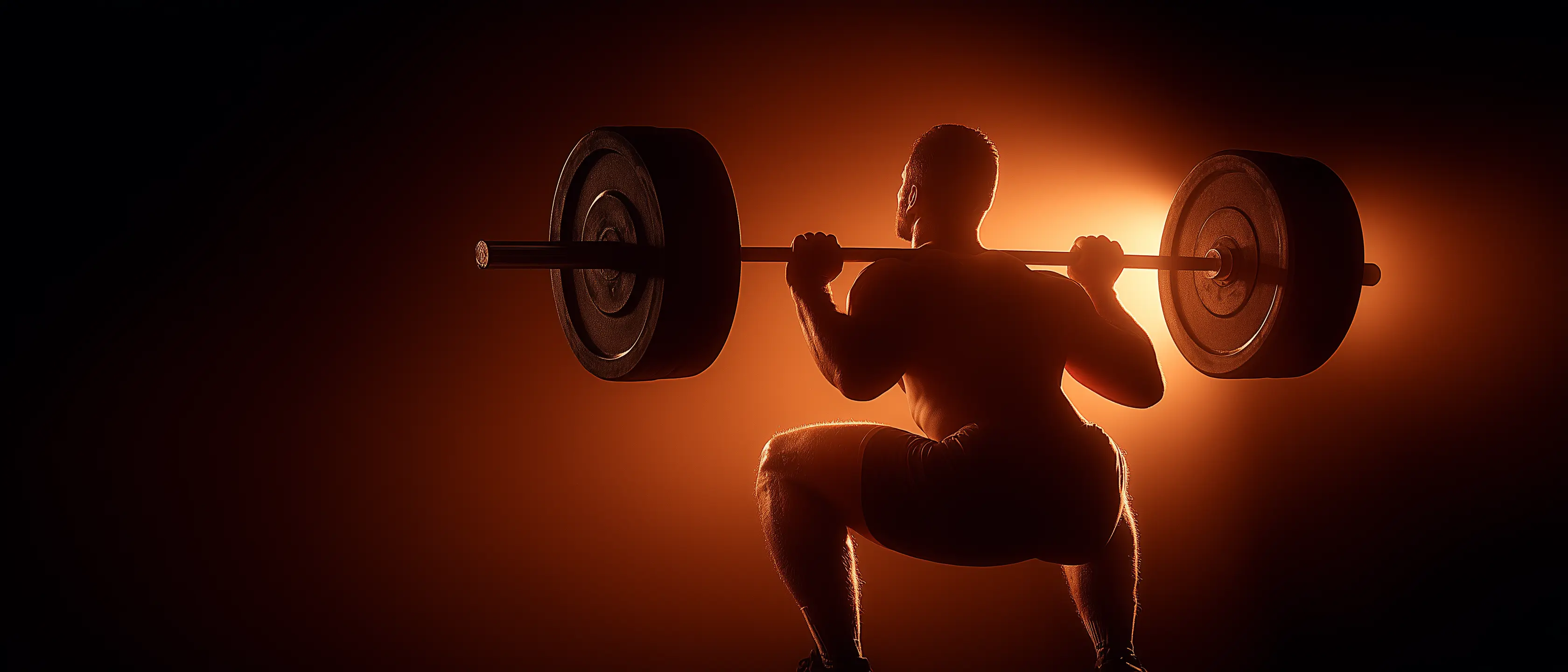
You descend into the squat, hit the bottom, and immediately bounce back up. The stretch reflex in your quads, hamstrings, and glutes fires and launches you out of the hole. You’ve been doing this every rep, every set, every workout.
Now imagine this instead: you descend, hit the bottom, and hold. Two seconds. Three seconds. The bar is heavy. Your muscles are screaming. There’s no bounce to save you. Then you stand up through pure strength.
That’s a paused squat. It’s one of the most effective accessory movements for building strength on the squat — the most frequently trained of the five 5x5 exercises — and it exposes weaknesses that regular squats let you hide behind momentum.
What is a paused squat?
A paused squat is exactly what it sounds like. You squat down to full depth — hip crease below the top of the knee — and hold that bottom position for a deliberate pause before standing back up.
The execution
- Unrack and set up exactly as you would for a normal squat. Same stance, same bar position, same bracing.
- Descend under control to full depth. Don’t dive-bomb into the hole — a controlled descent gives you a solid, stable bottom position.
- Hold at the bottom for 2-3 seconds. Don’t relax. Stay tight — maintain your brace, keep your knees pushed out, keep your chest up, and keep tension in your legs and back.
- Stand up without any downward dip or bounce. Drive straight up from the paused position. No momentum. No rocking forward. Just force production from a dead stop.
- Complete the rep by locking out at the top. That’s one paused rep.
What “hold” actually means
This is important: the pause is not a rest. You don’t relax at the bottom and then re-engage. You maintain full body tension throughout the entire pause. Your core stays braced, your upper back stays tight against the bar, your quads and glutes stay loaded.
If you relax at the bottom, you lose spinal position, your knees cave, and the weight shifts forward onto your toes. Staying tight under load is the entire point.
Why paused squats work
They eliminate the stretch reflex
When you squat normally, the rapid stretch of your muscles at the bottom creates an elastic energy storage called the stretch-shortening cycle. Your muscles and tendons act like a spring — they absorb energy on the way down and release it on the way up. This is the “bounce” at the bottom of a normal squat.
The stretch reflex contributes a meaningful amount of force to help you stand up. Estimates vary, but it may account for 10-15% of the force in the bottom portion of the squat.
A 2-3 second pause dissipates this stored energy. By the time you initiate the drive upward, the elastic contribution is gone. Every newton of force that moves the bar comes from muscular contraction alone.
This forces your muscles to develop the ability to produce force from a dead stop in the weakest position. That’s raw strength, not bounce.
They build strength at the sticking point
The bottom of the squat — the “hole” — is where you’re weakest. The joint angles are most disadvantageous, the moment arms are longest, and the muscles are in their most stretched position.
Most squat failures happen at or just above this point. The lifter gets stuck coming out of the hole and either grinds to a halt or dumps the bar.
Paused squats force you to spend extra time under load at exactly this position. Each paused rep is concentrated practice at your weakest point. Over weeks, this builds the specific strength needed to drive through the bottom portion of the squat.
They improve position awareness
When you pause at the bottom, you have time to feel what’s happening. Are your knees caving? Is your chest dropping? Is your weight on your toes? During a normal squat, the bottom position passes in a fraction of a second — too fast to notice problems.
The pause gives you 2-3 seconds of feedback. If something is wrong, you feel it. Over time, this builds an intuitive sense of what a good bottom position feels like — and you carry that awareness back into your regular squats.
They teach proper bracing under load
Maintaining a Valsalva brace for 2-3 seconds under heavy load in the most difficult position is demanding. It trains your core to hold intra-abdominal pressure through the entire rep, which directly improves your bracing during heavy regular squats.
Many lifters who lose tightness at the bottom of their squat find that paused squat practice fixes this problem. If you can stay braced for 3 seconds in the hole, staying braced through a normal bounce-and-go rep feels easy by comparison.
How to program paused squats on 5x5
Paused squats are an accessory, not a replacement for your main squat work. Here’s how to fit them into a 5x5 training week.
When to do them
After your main squat sets. Complete your 5x5 work sets first. Then do paused squats as a back-off accessory.
Example workout order:
- Squat 5x5 at working weight (e.g., 80 kg)
- Paused squat 3x3 at 50-60 kg
- Continue with bench/OHP and rows as normal
Weight selection
Start conservative. The pause makes everything harder than you expect.
- Week 1-2: 60% of your 5x5 working weight
- Week 3-4: 65% of your 5x5 working weight
- Week 5+: 70-75% of your 5x5 working weight
If you’re squatting 80 kg for your 5x5 work sets:
- Start paused squats at 48-50 kg
- Build toward 55-60 kg over several weeks
Don’t push paused squats above 75% of your working weight. The goal isn’t to overload — it’s to spend quality time in the bottom position with good mechanics.
Sets and reps
3x3 to 3x5 is the sweet spot. Paused squats are demanding because each rep includes several seconds of sustained tension in the hardest position. High rep sets (8+) degrade form because fatigue accumulates and your pause quality deteriorates.
Keep sets low, keep reps low, keep quality high.
How long to run them
Run a paused squat block for 4-8 weeks. This is enough time to build meaningful bottom-position strength. After the block, drop them and assess whether your regular squat has improved. Most lifters notice the difference within 3-4 weeks.
You can cycle them back in whenever you need another round. Some lifters keep one paused squat session per week year-round as maintenance.
When to add paused squats to your training
Don’t add them just because they sound cool. Add them when you have a specific problem they solve.
You struggle coming out of the hole
This is the primary use case. If your squat fails at or near the bottom — you descend, hit depth, and get stuck — paused squats directly address this weakness. They build the exact strength you’re missing.
Compare this to lifters who fail at lockout — their problem is different (usually quad weakness in the top range) and needs a different solution.
Your form breaks down at the bottom
If your knees cave, your chest drops, your weight shifts to your toes, or your back rounds as soon as you hit depth — you have a positional issue at the bottom. Paused squats give you time to practice and correct this position under load.
Film yourself during paused squats. Use the pause to check your position. Over time, good bottom position becomes automatic.
You’re afraid of the bottom
This is more common than people admit. Some lifters cut depth short not because they lack mobility, but because the bottom of a heavy squat is intimidating. The weight feels heaviest there. The position feels most vulnerable.
Paused squats desensitize you to the bottom. After spending hundreds of seconds holding heavy weight in the hole, you stop fearing it. The bottom position becomes familiar, not threatening.
You’ve hit a squat plateau
If your squat stalls on 5x5 and multiple deloads haven’t broken through, paused squats can provide a new stimulus. They address the bottom-position weakness that’s often the root cause of plateaus. For more plateau-breaking strategies, check the plateau guide.
As a deload variation
Instead of doing regular squats at reduced weight during a deload week, try paused squats at 50-60% of your working weight. You get reduced loading (easier on joints and connective tissue) with increased time under tension (maintains muscle stimulus). It’s a productive way to deload without feeling like you’re wasting a week.
Common mistakes
Going too heavy
This is the most common error. Lifters load 85-90% of their working weight because they don’t want to “go light.” Then they can barely hold the pause for one second, their form deteriorates, and the exercise stops doing what it’s supposed to do.
The pause is the training stimulus, not the weight. A perfectly controlled 3-second pause at 65% builds more bottom-position strength than a rushed half-second “pause” at 90%.
Not actually pausing
A common cheat: descending, briefly decelerating at the bottom without actually stopping, and then immediately driving up. This isn’t a paused squat — it’s a slow squat with a brief hesitation.
A real pause means the bar stops moving. Completely. For a full 2-3 seconds. If you’re unsure whether you’re pausing long enough, have someone count for you or film the set and check.
Relaxing at the bottom
Some lifters hit the bottom, pause, and relax their muscles during the hold — essentially sitting in the bottom position like they’re resting in a chair. This is dangerous. When you relax under load, your spine rounds, your knees drift inward, and your core loses pressure. Then when you try to stand up, you’re starting from a compromised position.
Stay tight. The entire pause should feel like you’re actively pushing against the floor, just not hard enough to move yet.
Rising on the toes
The pause reveals balance problems. If your weight is even slightly forward, you’ll feel it during the hold — and many lifters compensate by pressing through their toes to initiate the drive.
Drive through your whole foot, with emphasis on the mid-foot and heels. If you consistently rise on your toes during paused squats, your regular squat probably has the same problem — you just don’t notice it because the bounce carries you through.
Adding paused squats too early
If you’ve been training for less than 3-4 months and your squat is still progressing linearly on 5x5, you don’t need paused squats yet. Regular squats with progressive overload are giving you all the stimulus you need. Adding accessories before the main movement has stalled is unnecessary complexity.
Wait until you have a specific reason to add them.
The mental game
Nobody talks about this, but paused squats are as much a mental exercise as a physical one.
Holding a heavy barbell in the bottom of a squat — the most mechanically disadvantaged position — while your muscles burn and your brain screams at you to stand up or dump the bar, and choosing to stay there for 2-3 more seconds before driving up, is hard. Not just physically hard. Mentally hard.
This develops a quality that transfers to every heavy lift: comfort under discomfort. When you’ve held 70% of your working weight in the hole for 3 seconds, hitting the bottom of a regular squat and immediately bouncing out feels like a vacation. The confidence carries over.
Lifters who do paused squats regularly report feeling more confident at the bottom of heavy regular squats. The hole stops being the scary part. It becomes the part you’ve practiced the most.
Paused squats vs other squat accessories
Paused squats vs tempo squats
Tempo squats prescribe a specific speed for the descent (e.g., 3-4 seconds down). They build control and time under tension throughout the range of motion. Paused squats focus specifically on the bottom position.
Use tempo squats for general movement quality and control. Use paused squats for bottom-position strength.
Paused squats vs pin squats
Pin squats (squatting onto safety pins set at the bottom position, so the bar rests completely on the pins between reps) are more extreme than paused squats. They eliminate the stretch reflex even more completely and allow you to practice driving out of the absolute bottom.
Pin squats require a power rack with adjustable safety pins and are more technically demanding. Paused squats are more accessible and still provide most of the same benefit.
Paused squats vs box squats
Box squats involve sitting back onto a box at the bottom. They teach the sit-back pattern and can build explosive hip drive. However, they change the squat mechanics significantly — the sit-back pattern isn’t how a free squat works.
Paused squats maintain normal squat mechanics. You just add a hold at the bottom. The movement pattern is identical to your regular squat, which means the transfer is more direct.
How to start
If you’ve read this far and think paused squats would help your training, here’s a simple 4-week introduction:
Week 1: After your 5x5 squat work, do 3x3 paused squats with a 2-second pause at 60% of working weight.
Week 2: Same — 3x3 with a 2-second pause at 60%. Focus on position quality.
Week 3: Move to 3x3 with a 3-second pause at 65%.
Week 4: Move to 3x4 with a 3-second pause at 65%.
After 4 weeks, evaluate. Has your bottom-position confidence improved? Does the hole feel more comfortable during regular squats? If yes, continue for another 4 weeks and gradually increase to 70-75%. If the improvement is dramatic and your regular squat is progressing again, you can drop paused squats and bring them back when you need them next.
They’re not meant to be a permanent fixture. They’re a tool you reach for when the bottom of the squat needs work — and then put away when the job is done.
For the full squat technique breakdown and form cues on every lift, see the exercise guide.
Track your squat progress and know exactly when you need targeted work:
Track your 5x5 progress automatically
Built-in plate calculator, rest timer, and auto-progression. Free for iOS & Android.
Frequently asked questions
How long should I pause at the bottom of a paused squat?
Two to three seconds is the standard. Count 'one-one-thousand, two-one-thousand' in the bottom position. Some lifters go up to 5 seconds, but 2-3 is enough to eliminate the stretch reflex and build positional strength without making the exercise unnecessarily miserable.
How much less weight should I use for paused squats?
Start at 60-65% of your regular working weight. If you squat 100 kg for your 5x5 work sets, begin paused squats at 60-65 kg. You can work up to 75% over time, but ego-loading paused squats defeats the purpose. The pause, not the weight, is the stimulus.
Can paused squats replace regular squats on 5x5?
No. Paused squats are an accessory, not a replacement. Regular squats with progressive overload are the foundation of 5x5. Paused squats address specific weaknesses — they don't provide the same overall strength stimulus because you use significantly less weight.
Will paused squats help me squat deeper?
Yes. Spending time under load in the bottom position builds comfort, confidence, and mobility in deep positions. Many lifters who cut squats short due to fear or tightness find that paused squat practice makes full depth feel natural over time.
When should I add paused squats to my 5x5 program?
Add them when you have a specific reason: struggling out of the hole, form breakdown at the bottom, or hitting a squat plateau. Don't add them in your first few months of 5x5 when regular squats are still progressing well. They're a tool for when you need targeted bottom-position work.
Writes the Lift5x5 training blog. Over a decade under the bar running 5x5-style programs — practical strength advice with no BS, just barbells.
More about Erik →