Your first day of barbell training: what to expect
A complete walkthrough of your first barbell workout. What to bring, what to wear, how to warm up, and exactly what happens from the moment you walk in.
You’ve decided to start barbell training. Maybe you read about 5x5 and its progressive overload approach, maybe a friend recommended it, maybe you’re just tired of spinning your wheels on machines and want to try something that actually builds strength.
Whatever brought you here, you’re now staring down your first day in the weight room with a barbell. And it feels like a big deal.
It is a big deal. But it’s also more manageable than you think. The first session is mostly about showing up, learning the space, and getting under the bar. Here’s exactly what to expect from the moment you pack your gym bag to the moment you walk out.
What to bring
You don’t need much. Overcomplicating your gym bag is a form of procrastination.
The essentials
- Water bottle. You’ll be thirsty. Gym water fountains work but having your own bottle means you don’t need to leave your equipment.
- Flat-soled shoes. Converse Chuck Taylors, Vans, or any flat shoe with minimal cushioning. Running shoes are bad for squats and deadlifts because the squishy heel makes you unstable. If flat shoes are all you own, you’re already set. If not, any pair of cheap canvas shoes works.
- Your phone. You need it to track your workout - what exercises you did, what weight you used, how many reps you completed. An app like Lift5x5 makes this easy, but a notes app works too. This data matters because next session you need to know where to start.
What to wear
Comfortable clothes you can move in. T-shirt and shorts or joggers. Nothing restricts your range of motion, nothing you’re worried about getting sweaty. Avoid jeans, khakis, or anything with a stiff waistband - you’ll be squatting and you need your hips to move freely.
That’s it. You don’t need lifting gloves, a belt, wrist wraps, knee sleeves, chalk, or any other gear. Those things have their place eventually, but on day one they’re distractions. You need your hands, a bar, and some plates.
Arriving at the gym
If this is your literal first time at this gym, give yourself a few extra minutes.
Getting oriented
Most gyms offer a brief tour when you sign up. If you haven’t had one, take five minutes to walk the floor before you start. You’re looking for three things:
-
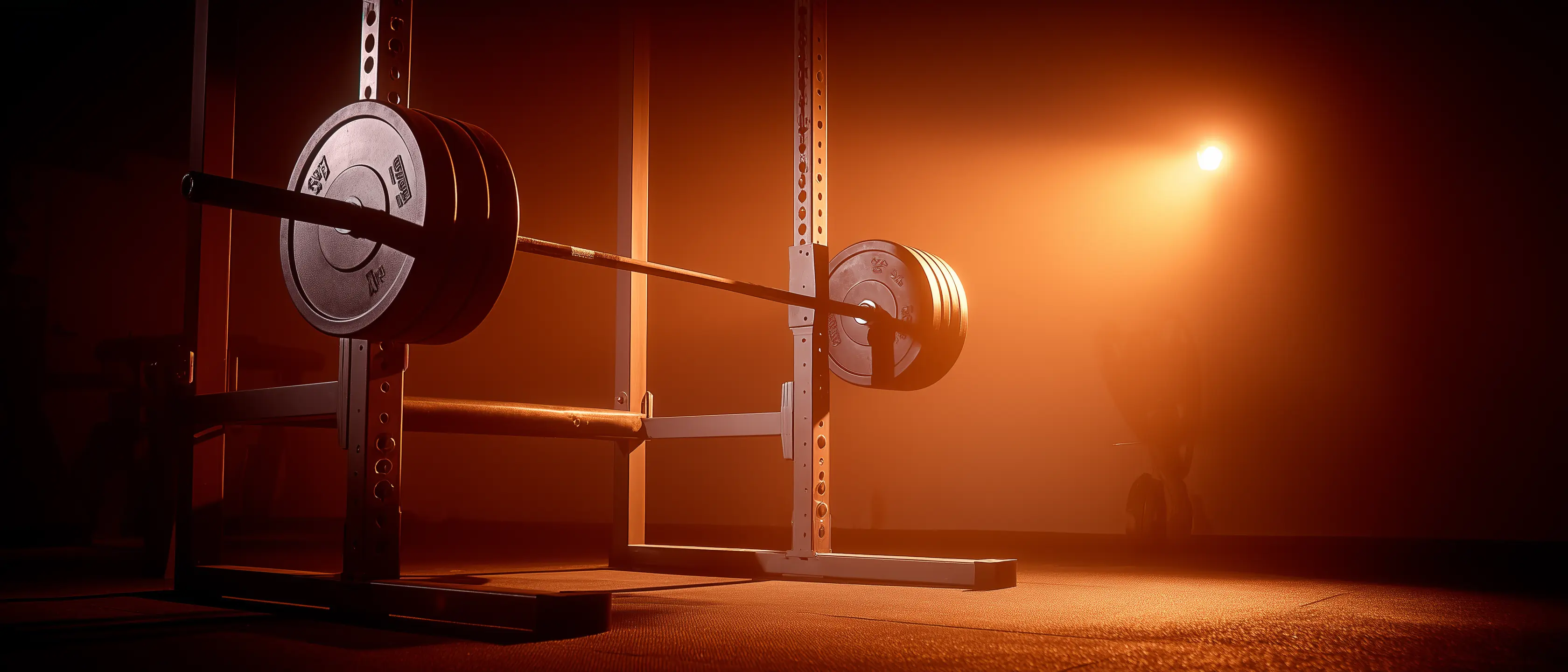
The squat rack (or power rack). This is the large metal frame with adjustable J-hooks for the barbell and horizontal safety bars. This is where you’ll squat and overhead press. Some gyms have dedicated squat racks that are open on one side. Others have full power cages with four posts. Either works.
-
The flat bench with a rack. This is for bench pressing. It looks like a padded bench with vertical posts at one end to hold a barbell. Some gyms keep these near the squat racks, others have a separate area.
-
A clear floor space. You need a few feet of open floor for barbell rows. Usually the area in front of the squat racks or the gym’s designated deadlift/free weight zone.
Don’t worry about locating every machine and cable station. You won’t need them today. You need a squat rack, a bench, and floor space. That’s your world for the next 45 minutes.
If equipment is taken
During busy hours, the squat rack might be occupied when you arrive. This is normal. You have a few options:
- Wait. Do your warm-up while you wait. Most people finish their squat sets in 15-20 minutes.
- Ask. Walk up between their sets and say “How many sets do you have left?” This is standard gym communication, not rude.
- Work in. Offer to alternate sets. You’ll probably be using much lighter weight, so there will be plate changing, but it works.
- Start with a different exercise. If the bench is free, start with bench press instead of squats. The order doesn’t matter much on day one.
The warm-up
Don’t skip this. A warm-up takes five minutes and prepares your body to move heavy things safely.
General warm-up: 5 minutes
Get on a treadmill, stationary bike, or rowing machine and move at a light pace for five minutes. The goal is to raise your body temperature and get blood flowing to your muscles. You should feel slightly warm, not out of breath. A brisk walk works. A light jog works. Easy rowing works.
If you hate cardio machines, jump rope for three minutes or do a few sets of bodyweight squats, arm circles, and leg swings. Any light movement that gets your heart rate up slightly.
Bar warm-up
Before your first working set of any exercise, do a few sets with just the empty bar. This isn’t about building strength - it’s about rehearsing the movement pattern and letting your joints and muscles prepare for the specific range of motion.
For squats, this might look like:
- 1 set of 10 reps with the empty bar (20kg/45lb)
- Rest 1 minute
- 1 set of 5 reps with the empty bar
- Rest 1 minute
- Begin your working sets
If your working weight is the empty bar itself, just do one warm-up set of 5-8 reps and then go into your five working sets. The warm-up with the general cardio was enough.
For a more detailed breakdown, check the warm-up sets guide.
Your first workout
On a standard 5x5 program, your first session is Workout A: squats, bench press, and barbell rows. Here’s what each one looks like when you’ve never done it before.
Squats: 5 sets of 5 reps
Walk up to the squat rack. The bar should be sitting on the J-hooks at roughly mid-chest height. If it’s too high or low, adjust the hooks before you get under it.
Step under the bar and position it across your upper back - across the meaty part of your traps, not on your neck bones. Grip the bar wider than shoulder width. Stand up to unrack it, take two small steps back, and set your feet about shoulder-width apart.
Take a breath, brace your core, bend your knees and hips simultaneously, and lower yourself until your hip crease goes just below the top of your knee. Then stand back up. That’s one rep.
Do that five times. Rest. Do it again. Five sets total.
With the empty bar, this will feel easy. Good. That’s the point. You’re learning a movement pattern, not testing your limits. The weight gets heavier every session - there’s no rush.
Bench press: 5 sets of 5 reps
Lie on the bench with your eyes directly under the barbell. Plant your feet flat on the floor. Arch your upper back slightly and squeeze your shoulder blades together - this creates a stable base and protects your shoulders.
Grip the bar slightly wider than shoulder width. Lift it off the rack with straight arms, lower it to your mid-chest (roughly nipple line), touch your chest, then press it back up. That’s one rep.
Five reps, five sets, same as squats. The bench feels natural for most people more quickly than the squat does. Don’t rush the descent - lower the bar under control.
Barbell rows: 5 sets of 5 reps
Set a barbell on the floor, or take it from the squat rack and place it down. Stand with your feet under the bar, about hip-width apart. Bend at the hips until your torso is roughly 45 degrees to the floor. Grip the bar just outside your knees.
Pull the bar to your lower chest, squeezing your shoulder blades together at the top. Lower it back down. That’s one rep.
Rows feel weird at first. You’re bent over, you can’t really see yourself, and the balance takes a session or two to figure out. That’s normal. Start light and focus on pulling with your back, not your arms.
How long it will take
Plan for about 60 minutes for your first session. Here’s a rough breakdown:
- Warm-up: 5-10 minutes
- Squats (including warm-up sets): 15-20 minutes
- Bench press (including warm-up sets): 12-15 minutes
- Barbell rows (including warm-up sets): 12-15 minutes
- Figuring things out: 5-10 minutes
That last line is real. You’ll spend time adjusting rack heights, loading plates for the first time, figuring out where things are, and occasionally standing there thinking “wait, which exercise is next?” That’s fine. It gets faster every session.
Within a few weeks, the whole workout takes 45 minutes unless the weights are getting heavy, in which case you’ll need longer rest periods and it stretches to 60-75 minutes.
It will feel awkward
Let’s address this directly: your first day will feel clumsy. You’ll put plates on the wrong side first. You’ll adjust the rack three times before it’s right. You’ll forget how many reps you did and have to start the set over. You’ll walk to the wrong piece of equipment and walk back.
This is universal. Every single person who trains with barbells went through this phase. The guy squatting 180kg in the corner? He once spent five minutes trying to figure out how the J-hooks work.
The awkwardness fades fast. By your third session, the setup is automatic. By your second week, you navigate the gym like you’ve been going for months. Your body and brain are remarkably good at adapting to new environments - you just have to give them a few exposures.
If gym anxiety is a significant concern, know that nobody is watching you figure things out. Everyone is focused on their own workout. The spotlight effect - the feeling that everyone is staring - is a well-documented cognitive bias that dramatically overstates how much attention others pay to you.
After the workout
You finished your three exercises, five sets each. Congratulations - the hardest part of starting barbell training is behind you.
Record everything
Before you leave the gym, write down:
- Which workout you did (A or B)
- What weight you used for each exercise
- How many reps you completed per set
This data is essential. Next session, you need to know your starting point. If you used the empty bar for everything today, next session you’ll add 2.5kg to squats, bench, and rows (or 5kg to deadlift if you’re on Workout B). Without records, you’re guessing.
An app makes this effortless - track your lifts and the progression math is done for you.
Eat a meal
Within a couple of hours after training, eat a real meal with protein. A chicken breast and rice, a couple of eggs on toast, a protein shake with a banana - whatever you’ll actually eat. You don’t need to obsess over timing or macros on day one. Just eat. Your muscles are primed to absorb nutrients after training, and giving them food helps recovery.
For a deeper dive into nutrition, read the 5x5 nutrition guide.
Stretching is optional
Light stretching after training can feel good, especially in your hips and hamstrings after squats. But it’s not mandatory. If you want to spend five minutes stretching, great. If you want to shower and leave, also great. Don’t force a stretching routine you won’t stick with.
What to expect the next day
You will be sore. Even if you used the empty bar.
This is called delayed onset muscle soreness, or DOMS. It peaks about 24-48 hours after your workout. Your legs will feel it the most from squats - especially going down stairs. Your chest and shoulders might be tight from bench press. Your upper back will remind you that rows exist.
DOMS is not a sign that you overdid it (assuming you started light). It’s a normal physiological response to new stimulus. Your muscles experienced something unfamiliar, and they’re adapting.
The soreness is worst after your first session and gets progressively milder as your body adapts. By the second week of training, you’ll barely notice it. Some lifters actually miss that first-week soreness once it’s gone - it felt like proof they did something.
Train through it
When your next workout day arrives - typically two days later - you may still be somewhat sore. Train anyway. The warm-up will reduce the soreness, and training through mild DOMS actually helps your recovery. Your muscles need consistent stimulus, not prolonged rest.
The only exception is sharp, localized pain that doesn’t improve with warm-up. That’s different from the generalized achiness of DOMS and worth paying attention to. Soreness is normal. Pain in a specific joint or one side of your body is a signal to be cautious.
The hardest part is done
Your first day in the gym with a barbell is the single biggest hurdle in your training career. Everything after this gets easier. Not the weights - those get heavier. But the logistics, the confidence, the familiarity with the space and the movements - all of that improves rapidly.
By day three, you know where everything is. By week two, you have a rhythm. By month one, the gym feels like a second home, and you’ll wonder why you were ever nervous about walking in.
The first day matters because you showed up. You loaded a bar, you moved some weight, you started the process. Thousands of strong people started exactly where you are right now - doing awkward squats with an empty bar and wondering if they’re doing it right.
They were. And so are you. Once you’ve nailed day one, the progression system takes care of the rest.
Track your 5x5 progress automatically
Built-in plate calculator, rest timer, and auto-progression. Free for iOS & Android.
Frequently asked questions
What if I don't know how to do the exercises?
Watch a form video for each exercise before you go. You don't need to memorize everything - just understand the basic movement pattern. Squat: bar on back, bend knees, go down and up. Bench: bar on chest, push up. Row: bend over, pull bar to chest. Start with the empty bar and focus on getting comfortable with the movement. Your form doesn't need to be perfect on day one. It needs to be safe and roughly correct. Perfection comes with practice.
What if all the squat racks are taken?
Wait a couple of minutes, or ask someone how many sets they have left. During off-peak hours this is rarely a problem. If the gym is busy, you can start with a different exercise - do bench press first, then squat when a rack opens. The exercise order doesn't matter much for your first session. You can also ask to work in, which means alternating sets with the other person.
How sore will I be the next day?
If you start with light weight like you should, the soreness will be mild to moderate. You'll feel it most in your legs from squats and in your upper back from rows. This is called DOMS (delayed onset muscle soreness) and it peaks 24-48 hours after your workout. It's completely normal and not a sign of injury. It gets dramatically better after your first week of training.
Do I need a gym buddy for my first day?
No. A training partner can be nice for moral support, but 5x5 is designed to be done solo. You don't need a spotter on your first day because the weights will be light. The squat rack has safety bars that catch the weight if you fail. Thousands of people train alone every day - you'll be fine.
What if I can't finish all the sets?
If you started with the empty bar or a light weight and can't finish 5 sets of 5, that's useful information. It tells you the weight you chose was right at your limit, which is actually a fine place to start. Record what you did - maybe you got 5, 5, 5, 4, 3 - and try the same weight next session. Don't add weight until you complete all prescribed sets and reps.
Writes the Lift5x5 training blog. Over a decade under the bar running 5x5-style programs — practical strength advice with no BS, just barbells.
More about Erik →