Squat knee pain: why it happens and how to fix it
Knee pain from squats is almost always fixable. Learn the 5 main causes, why deep squats are actually safer for your knees, and how to fix each issue.
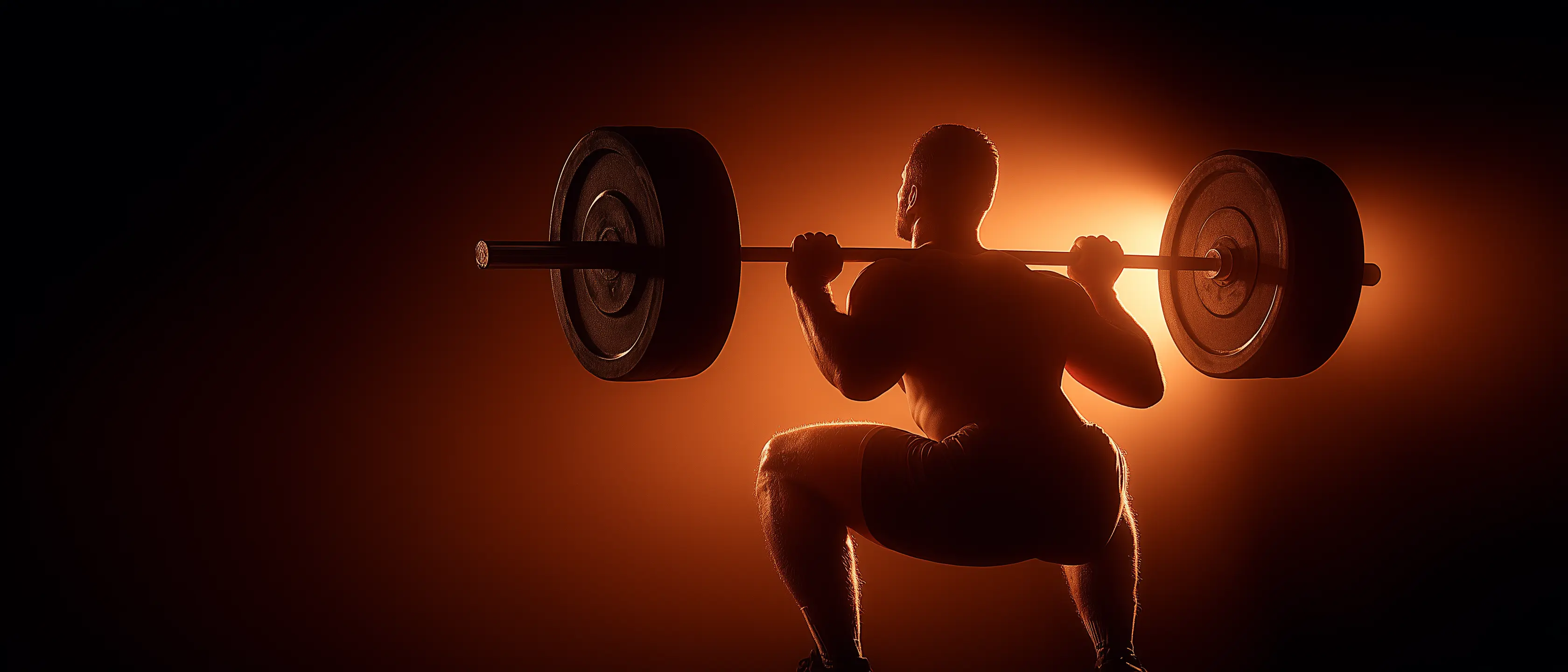
Knee pain during squats is incredibly common. It’s also one of the most misunderstood issues in the gym.
Walk into any commercial gym and you’ll hear someone say squats — one of the five fundamental 5x5 exercises — are bad for your knees. They’ll point to their creaky joints as proof. But the research points the other way: a systematic review in Sports Medicine concluded that deep squats performed with good technique do not raise injury risk for healthy knees and can strengthen the structures around the joint.
The pain isn’t coming from the squat. It’s coming from how you’re squatting.
The counterintuitive truth about squat depth
Here’s something that surprises most people: partial squats — stopping above parallel — put more stress on your knees than full-depth squats.
Why deep is safer
At the bottom of a full squat (hip crease below the top of the knee), your hamstrings wrap around the back of the knee joint. This creates a “wrapping force” that counterbalances the forward shear force on the knee. Your knee is actually in its most protected position at the deepest point of a proper squat.
Stop above parallel and you lose that protective hamstring wrapping. The quadriceps are pulling hard on the patellar tendon, and there’s no counterbalancing force from the hamstrings. All the stress goes into the front of the knee.
A 2001 biomechanical review published in Medicine & Science in Sports & Exercise examined shear and compressive forces across the full squat and concluded that the squat, performed correctly, loads the cruciate ligaments well within their tolerance and is a safe exercise for the knee — including at full depth.
This doesn’t mean everyone should immediately squat as deep as possible. Mobility limitations might prevent you from reaching full depth with good form. But it does mean that deliberately cutting depth short isn’t protecting your knees — it’s doing the opposite.
For a detailed guide on how deep you should squat, read the squat depth article.
Cause 1: knee cave (valgus)
Knee valgus — where the knees collapse inward during the squat — is the most common fixable cause of knee pain. It’s also one of the easiest to spot.
What’s happening
When your knees cave inward, the stress on the knee is no longer distributed evenly. The medial (inner) structures of the knee — the MCL, medial meniscus, and medial patellar facet — take excessive load. Meanwhile, the lateral structures are being stretched.
This uneven loading irritates the joint over time and is a common pathway to medial knee pain and patellar tracking issues.
Why it happens
- Weak glutes and hip abductors. These muscles are responsible for pushing your knees outward. If they’re weak, your knees default inward under load.
- Poor motor control. Your muscles are strong enough, but your brain isn’t sending the right signals under load.
- Too much weight. When the load exceeds your ability to maintain position, form breaks down and knees cave first.
How to fix it
Cue “knees out.” The simplest fix is conscious effort. Think about pushing your knees toward the wall on either side of you as you squat.
Banded squats. Put a light resistance band just above your knees. Squat with the band, forcing your hip abductors to work to keep your knees out. Do 2-3 sets of 10 as part of your warm-up.
Reduce the weight. If your knees cave on your working sets, the weight is too heavy for your current ability to maintain proper form. Drop 10-20% and rebuild with correct knee tracking.
Glute activation work. Before squatting, do clamshells, lateral band walks, or single-leg glute bridges to wake up the muscles responsible for knee position.
Cause 2: poor ankle mobility
This one flies under the radar. Most people don’t realize their knee pain originates at the ankle.
What’s happening
Adequate ankle dorsiflexion — the ability to bend your ankle so your knee travels forward over your toes — is essential for a proper squat. When ankle mobility is restricted, your body compensates.
Common compensations for limited ankle mobility:
- Heels rise off the floor. Weight shifts to the balls of your feet, increasing stress on the patellar tendon.
- Excessive forward lean. Your body tilts forward to keep the bar over mid-foot, loading the lower back.
- Knees don’t travel forward enough. Your squat becomes more of a good-morning, shifting stress to the hips and lower back while keeping the knees at the worst angle for shear force.
- Feet turn out excessively. Your body finds external rotation to compensate for the ankle restriction.
All of these compensations change the force distribution at the knee.
How to fix it
Test your ankle mobility: Face a wall with your toes about 10 cm (4 inches) away. Try to touch your knee to the wall without your heel lifting. If you can’t, you have restricted ankle dorsiflexion.
Ankle dorsiflexion stretch (daily):
- Kneel with one foot in front, toes about 10 cm from a wall
- Drive your knee forward over your toes toward the wall
- Keep your heel flat on the ground
- Hold for 30 seconds, 3 reps each side
- Gradually move your foot further from the wall as mobility improves
Elevated heel squatting. While you work on mobility, placing 2.5 kg plates under your heels or wearing squat shoes with a raised heel compensates for the restriction. This is a legitimate tool, not a crutch. Many elite Olympic weightlifters squat in heeled shoes for exactly this reason.
Foam roll your calves. Tight calves restrict ankle dorsiflexion. Spend 1-2 minutes rolling each calf before squatting.
Cause 3: too much too soon
Progressive overload is the foundation of getting stronger. But your joints adapt more slowly than your muscles.
What’s happening
Muscle tissue can increase strength by 10-15% in a month with proper training. Tendons and cartilage? They adapt on a timeline of weeks to months. When you load the squat aggressively — jumping weight up faster than the program prescribes, or adding extra squat volume — your muscles can handle it but your patellar tendon can’t.
The result is patellar tendinitis (sometimes called “jumper’s knee”), the most common tendon issue in squatters. You’ll feel it as a sharp or aching pain just below your kneecap, right where the patellar tendon attaches to the tibial tuberosity.
How to fix it
Follow the program. On 5x5, that means 2.5 kg per successful workout. Not 5 kg. Not 2.5 kg per set. 2.5 kg per workout. The increments are small for a reason — they allow your connective tissue to keep up.
Don’t add extra volume. Your joints need to adapt to the volume you’re already doing. Adding leg extensions, extra squat sets, or running on top of 5x5 gives your patellar tendon no time to recover.
If tendinitis develops: Reduce load by 10-20%, maintain training frequency, and slowly build back up. Complete rest is usually counterproductive for tendinitis — controlled loading is actually part of the treatment. Isometric holds (wall sits for 30-45 seconds) at moderate intensity can help manage tendon pain.
Read more about proper loading in how much weight to add each workout.
Cause 4: excessive forward knee travel without adequate quad strength
Let’s be clear: knees going past your toes is not inherently bad. A 2003 study in the Journal of Strength and Conditioning Research found that artificially blocking the knees from traveling forward shifted load onto the hips and lower back — so the popular advice to keep knees behind the toes simply moves stress elsewhere rather than removing it.
What’s happening
However, if your knees travel far forward and your quadriceps aren’t strong enough to control the descent and drive out of the bottom, the patellar tendon takes excessive strain. This isn’t about the position being wrong — it’s about lacking the strength to control that position.
This is most common in lifters with long femurs (thigh bones) relative to their torso. They naturally need more forward knee travel to maintain an upright torso and keep the bar over mid-foot.
How to fix it
Strengthen the quads. This sounds circular, but the squat itself builds quad strength progressively. If you started with proper weight (the empty bar) and added 2.5 kg per session, your quads adapt. Problems arise when people start too heavy.
Tempo squats. Once a week, do a set of squats with a 3-second descent. This builds strength and control in the exact positions where your quads are working hardest.
Stance adjustment. A slightly wider stance with more toe-out angle reduces how far forward your knees need to travel. Experiment with small changes — an inch wider on each side.
Cause 5: existing conditions made worse by poor load management
Some people come to the squat rack with pre-existing knee conditions: previous meniscus injuries, mild osteoarthritis, or chondromalacia (roughening of the cartilage behind the kneecap).
What’s happening
These conditions don’t necessarily prevent you from squatting. But they require smarter load management. Jumping in with too much weight, not warming up adequately, or training through flare-ups can aggravate an existing condition that would otherwise respond well to controlled strength training.
How to fix it
Thorough warm-up. If you have a history of knee issues, your warm-up matters more than anyone else’s. Start with 5 minutes of stationary cycling or walking to increase joint temperature and synovial fluid production. Then do bodyweight squats (2 x 10), progressing to empty bar and working weight.
Controlled depth. If full depth aggravates a pre-existing condition, squat to the depth that’s pain-free and work on gradually increasing it over weeks and months. Some depth is better than no squatting at all.
Consult a professional. If you have a diagnosed knee condition, a sports physiotherapist can help you determine the right squat variation, depth, and loading strategy for your specific situation.
Warm-up protocol for knee health
This takes less than 10 minutes and can prevent most squat-related knee issues.
General warm-up (3-5 minutes):
- Stationary bike, walking, or light rowing
- Goal: increase joint temperature and synovial fluid production
Dynamic warm-up (3-5 minutes):
- Leg swings (front to back): 10 each leg
- Leg swings (side to side): 10 each leg
- Ankle circles: 10 each direction, each ankle
- Bodyweight squats: 2 sets of 10, focusing on knee tracking
Mobility work (as needed):
- Ankle dorsiflexion drill: 30 seconds each side
- Goblet squat hold: squat down with a light weight, sit in the bottom for 30-60 seconds, push knees out with elbows
- Hip circles: 10 each direction
Then move into your barbell warm-up sets as normal: empty bar, then progressively add weight until you reach your working weight.
Knee sleeves: do they actually help?
Knee sleeves are popular. But what do they actually do?
What they provide
- Warmth. Neoprene sleeves keep the knee joint warm, which reduces stiffness and may improve comfort during training. This is their primary benefit.
- Proprioception. The compression provides sensory feedback about knee position, which may help with maintaining proper tracking.
- Mild compression. Some evidence suggests compression can reduce swelling after training.
What they don’t provide
- Structural support. A neoprene sleeve is not a knee brace. It won’t prevent your knee from caving, won’t stabilize a torn ligament, and won’t compensate for poor form.
- A substitute for fixing the cause. If your knees hurt because of form issues, sleeves might make them feel better temporarily while the underlying problem persists.
Should you use them?
If you like how they feel — yes. They’re a tool, not a dependency. Many lifters use them for the warmth and comfort, especially in cold gyms. Just don’t rely on them to fix a problem that requires form correction or load management.
When to see a doctor
Most squat knee pain is fixable with the corrections above. But some situations require professional evaluation.
See a professional if:
- Pain persists for more than 2-3 weeks despite form corrections and load reduction
- Sharp pain inside the joint (not muscular)
- Swelling that doesn’t resolve within 48 hours
- Locking or catching sensation (the knee “sticks” at a certain angle)
- Giving way (the knee buckles or feels unstable under load)
- Pain at rest or at night
- Any clicking accompanied by pain
Specifically concerning signs:
- Pain on the inner or outer joint line (possible meniscus issue)
- Significant swelling after a single session (possible ligament involvement)
- Pain below the kneecap that worsens with stairs (likely patellar tendinitis — manageable but may need professional guidance)
A sports medicine doctor or physiotherapist can perform specific physical tests, order imaging if needed, and create a return-to-training plan. Most knee issues in recreational lifters are minor and resolve with proper management.
Fix the cause, keep squatting
Squat knee pain is a signal, not a sentence. It’s telling you something needs adjustment — your form, your loading, your warm-up, or your mobility.
Address the cause and the pain resolves. The squat itself is one of the best exercises for long-term knee health. People who squat properly throughout their lives have stronger, healthier knees than people who avoid loading them entirely.
Don’t let temporary pain scare you away from an exercise that will protect your knees for decades. For the full technique breakdown of the squat and every other lift, see the exercise guide.
Track your squat progress and spot patterns before pain becomes a problem:
Track your 5x5 progress automatically
Built-in plate calculator, rest timer, and auto-progression. Free for iOS & Android.
Frequently asked questions
Is it bad if my knees go past my toes when I squat?
No. This is one of the most persistent myths in fitness. A 2003 study in the Journal of Strength and Conditioning Research found that restricting forward knee travel actually increased stress on the hip and lower back while barely reducing knee forces. Your knees going past your toes is a natural part of squatting, especially for taller individuals or those with longer femurs. What matters is that your knees track over your toes and don't cave inward.
Should I squat through knee pain?
Mild discomfort that warms up after the first few sets and doesn't worsen is generally okay to train through while addressing the cause. Sharp pain, pain that increases during the workout, or pain that causes you to alter your movement pattern means stop. Continuing to squat with altered mechanics often creates new problems.
Do I need knee sleeves?
Knee sleeves are optional. They provide warmth (which can reduce stiffness), compression, and proprioceptive feedback — a subtle reminder of knee position during the lift. They won't meaningfully support a weak or injured knee structurally. If you like how they feel, use them. If you don't, you're not missing out on safety.
Will squatting damage my knees long-term?
The evidence says no. A 2013 systematic review in Sports Medicine found that competitive weightlifters who squat heavy and deep throughout their careers have similar or better knee health than non-athletes. Proper squatting actually strengthens the structures around the knee. It's poor form and excessive loading without adequate recovery that cause problems, not the squat itself.
Can I squat with arthritis in my knees?
Often yes, and it's frequently recommended. Controlled resistance training helps manage osteoarthritis by strengthening the muscles around the joint, improving joint stability, and reducing pain. Start with bodyweight or light loads, go to a comfortable depth, and increase gradually. Consult your doctor for guidance specific to your situation.
Writes the Lift5x5 training blog. Over a decade under the bar running 5x5-style programs — practical strength advice with no BS, just barbells.
More about Erik →