Close grip bench press for triceps and strength
How to do close grip bench press correctly, why it builds your regular bench, and how to program it as an accessory on 5x5. Form, weight, and common mistakes.
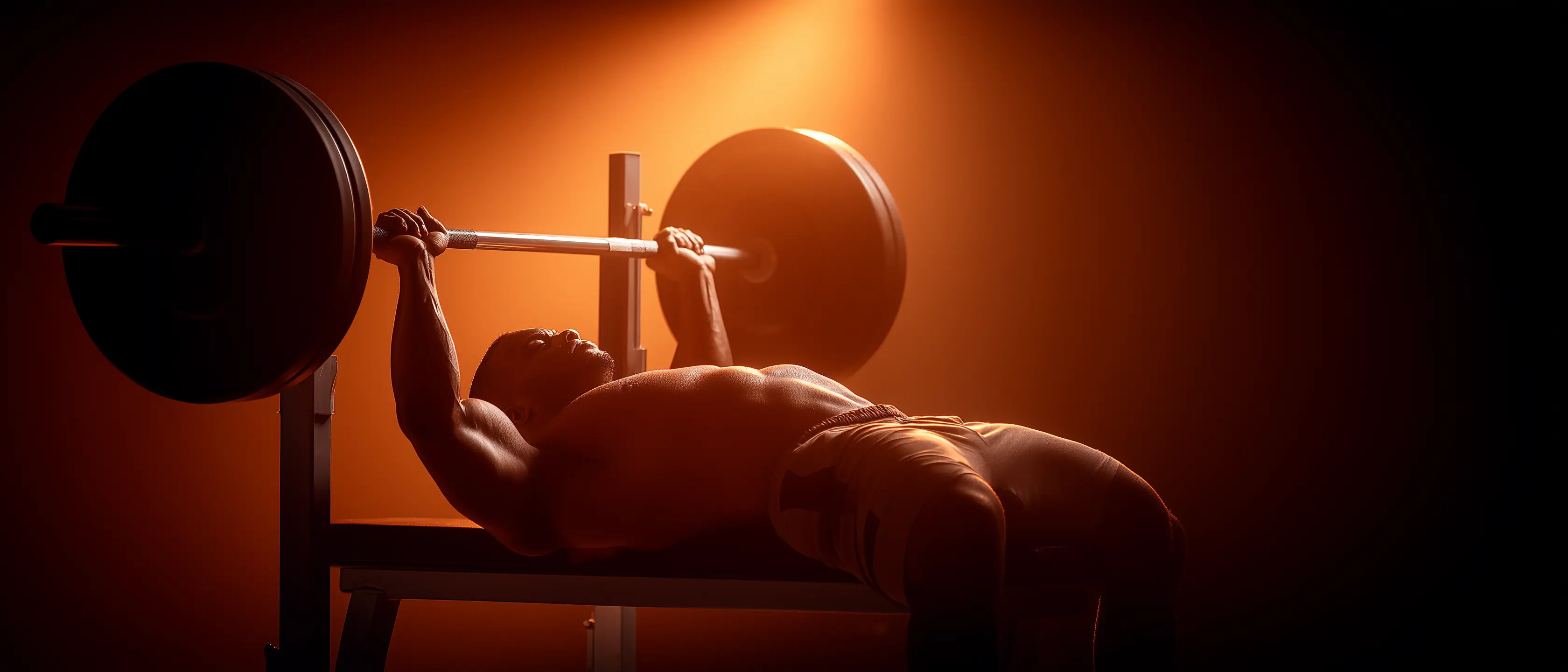
Your bench press stalls. You grind through the first three reps and then the bar stops halfway up on rep four. The sticking point is always the same — somewhere between the chest and lockout, your arms just can’t finish the press.
That sticking point is a tricep problem. The chest and front delts do most of the work off the chest, but the triceps take over in the top half of the movement. Weak triceps mean a weak lockout, and a weak lockout means a stalled bench press.
The close grip bench press is the most direct way to fix this. It builds on the standard bench press technique you already know, with a small grip adjustment that shifts the emphasis squarely onto your triceps and the lockout portion of the press.
What close grip bench press is (and isn’t)
Close grip bench press is a standard bench press performed with your hands at shoulder width instead of the wider grip used for the regular bench press. That’s the entire difference. Same bench, same bar path, same setup — just a narrower grip.
What it’s not: hands touching in the middle of the bar. The “close” in close grip is relative to your normal bench grip. If your standard grip is about 1.5x shoulder width, close grip brings your hands in to 1x shoulder width.
Muscles targeted
The grip change shifts the workload between muscle groups:
Standard bench grip: chest is the primary mover, with shoulders and triceps assisting. The wider your grip, the more chest involvement.
Close grip: triceps become the primary mover, with chest and shoulders assisting. The narrower grip increases the range of motion at the elbow, which means your triceps work harder through a longer arc.
Close grip bench also hits the upper chest slightly more than a wider grip because of the elbow position. It’s not a major difference, but it’s there.
Proper form
If you already bench press with good form, close grip bench requires only two adjustments: hand position and elbow path. Everything else stays the same.
Setup
Lie on the bench with your eyes under the bar, just like a regular bench press. Pull your shoulder blades together and down — this creates the stable base your shoulders need. Arch your upper back slightly. Plant your feet flat on the floor.
Hand position
Place your hands at shoulder width. For most people, this means your index or middle finger sits at the inside edge of the knurling. Your forearms should be roughly vertical when the bar is on your chest.
A simple test: lie on the bench, extend your arms straight up, and note where your hands naturally fall. That’s approximately your close grip width.
Do not go narrower than shoulder width. Placing your hands closer together doesn’t increase tricep activation — it shifts the stress onto your wrists and forces them into an awkward angle. This is the single most common mistake on close grip bench and the reason many people experience wrist pain with the exercise. Your hands should always remain on the knurled portion of the bar.
Elbow path
This is the key difference in execution. On a standard bench press, your elbows flare out to roughly 45-75 degrees from your body. On close grip bench, keep your elbows tucked tight — closer to 20-30 degrees from your torso.
Think about pointing your elbows toward your hips as you lower the bar. This keeps the triceps in a mechanically advantageous position throughout the movement and protects your shoulders.
Bar path
Unrack the bar and hold it directly over your shoulders. Lower it in a slight diagonal toward the lower chest — the bar should touch at or just below your nipple line. This is slightly lower than where a standard bench press typically lands.
Press the bar back up and slightly toward your face, returning to the lockout position over your shoulders. The bar path is essentially the same as a regular bench press, just slightly more vertical because of the narrower grip.
Breathing and bracing
Same as regular bench press. Big breath at the top, hold it as you lower the bar, brace your core, press, and exhale at lockout. If you need a refresher on bracing, the principles are the same as in the bench press form guide.
Why it helps your regular bench press
Close grip bench isn’t just a tricep isolation exercise. It has direct, specific carryover to your competition or standard bench press. Here’s why.
Stronger lockout
If your bench press fails in the top half of the movement, your triceps are the weak link. Close grip bench overloads the triceps through the exact range of motion where they’re responsible for finishing the press. Stronger triceps means heavier lockout means a bigger bench.
Bigger triceps
The triceps make up roughly two-thirds of your upper arm mass. Bigger triceps provide more muscle to contribute to the bench press. They’re also involved in overhead pressing, which makes close grip bench a useful accessory for your overhead press as well.
Better elbow tracking
Close grip bench forces you to keep your elbows tucked. This reinforces good elbow mechanics that protect your shoulders during regular bench pressing. Many lifters who struggle with shoulder pain on bench find that close grip bench work improves their elbow path on the standard press.
Neural carryover
The movement pattern is nearly identical to a regular bench press. Your nervous system practices the same coordination, the same stabilization demands, and the same bar path. Volume on close grip bench is essentially extra bench press practice for your brain.
Programming close grip bench on 5x5
The key principle: close grip bench is an accessory, not a replacement for your main bench work. Do your 5x5 bench press first, then add close grip bench afterward.
Recommended approach
When: after your 5x5 bench press on Workout A days. If you’re also adding other accessories, close grip bench is one of the most productive choices for upper body days.
Sets and reps: 3 sets of 8-10 reps. This rep range balances hypertrophy (muscle growth) and strength for the triceps.
Weight: start with 60% of your regular bench press and adjust. You should be able to complete all reps with good form but the last 1-2 reps of each set should feel challenging. Most lifters settle at 70-80% of their regular bench for sets of 8-10.
Progression: add 2.5 kg when you can complete 3x10 with good form. This is slower than your main lift progression, and that’s fine. Accessory work progresses in the background while your main lifts stay the priority.
Sample Workout A with close grip bench
- Squat — 5x5
- Bench press — 5x5
- Barbell row — 5x5
- Close grip bench press — 3x8-10
- (Optional) ab work — 3 sets
Total added time: 8-12 minutes.
Common mistakes
Going too narrow
Hands inside shoulder width forces your wrists into ulnar deviation — they bend inward toward your body. Under load, this creates significant wrist strain. It also reduces the weight you can handle, which means less training stimulus.
If your wrists hurt during close grip bench, your grip is almost certainly too narrow. Widen it to shoulder width and the problem usually disappears immediately.
Flaring elbows
If your elbows drift outward to 45+ degrees, you’ve turned the exercise back into a regular bench press. The whole point of close grip bench is keeping the elbows tight to load the triceps. Cue yourself: “elbows to ribs.”
Too much weight
Ego loading on accessories defeats their purpose. If you’re grinding out ugly singles on close grip bench, you’re training your compensations, not your triceps. Use a weight that allows clean, controlled reps with a clear pause on the chest.
Bouncing off the chest
Let the bar touch your chest, pause briefly, then press. Bouncing eliminates the hardest part of the rep — the initial drive off the chest — and reduces training effect. Control the descent, touch, press.
Close grip bench vs other tricep exercises
If you’re choosing one tricep accessory for your 5x5 program, here’s how close grip bench compares to the alternatives.
vs Dips
Dips are excellent for tricep development and allow progressive loading with a weight belt. The downside: they require shoulder flexibility, and some lifters experience shoulder or sternum pain. Close grip bench is generally more shoulder-friendly and has more direct bench press carryover because it’s the same movement pattern.
If you tolerate dips well, they’re a viable alternative. If you had to pick one, close grip bench wins for bench press specificity.
vs Skull crushers (lying tricep extensions)
Skull crushers isolate the triceps effectively but use significantly less weight and place considerable stress on the elbow joint. Many lifters develop elbow tendinitis from heavy or frequent skull crushers. Close grip bench distributes the load across multiple joints and allows heavier loading, which means more stimulus with less joint stress.
For lifters who already have elbow issues, skull crushers often aggravate the problem while close grip bench is usually tolerable.
vs Tricep pushdowns
Pushdowns are a cable isolation exercise — useful for extra volume but limited in loading and specificity. They don’t replicate the bench press pattern at all. Close grip bench is a better use of your limited accessory time if your goal is a bigger bench press.
Pushdowns have a role as a warm-up or finisher, not as a primary tricep builder for strength athletes.
Putting it together
Close grip bench press is one of the most effective accessories you can add to 5x5. It directly targets the triceps that drive your bench press lockout, it reinforces good elbow mechanics, and it uses a movement pattern you already know.
Keep the grip at shoulder width, the elbows tucked, and the weight moderate. Three sets of 8-10 after your main bench work is all you need to see meaningful improvement in both tricep size and bench press performance.
If your bench press stalls and the sticking point is in the top half of the rep, close grip bench is your first move. Fix the lockout and the weight goes up. For form cues on the bench press and all five 5x5 exercises, review the guide.
Track your 5x5 progress automatically
Built-in plate calculator, rest timer, and auto-progression. Free for iOS & Android.
Helping lifters get stronger with the simplest program that works. No BS, just barbells.