Choosing a power rack for your home gym
A power rack is the most important home gym purchase. Types, key features, size requirements, and budget tiers to help you pick the right one for 5x5.
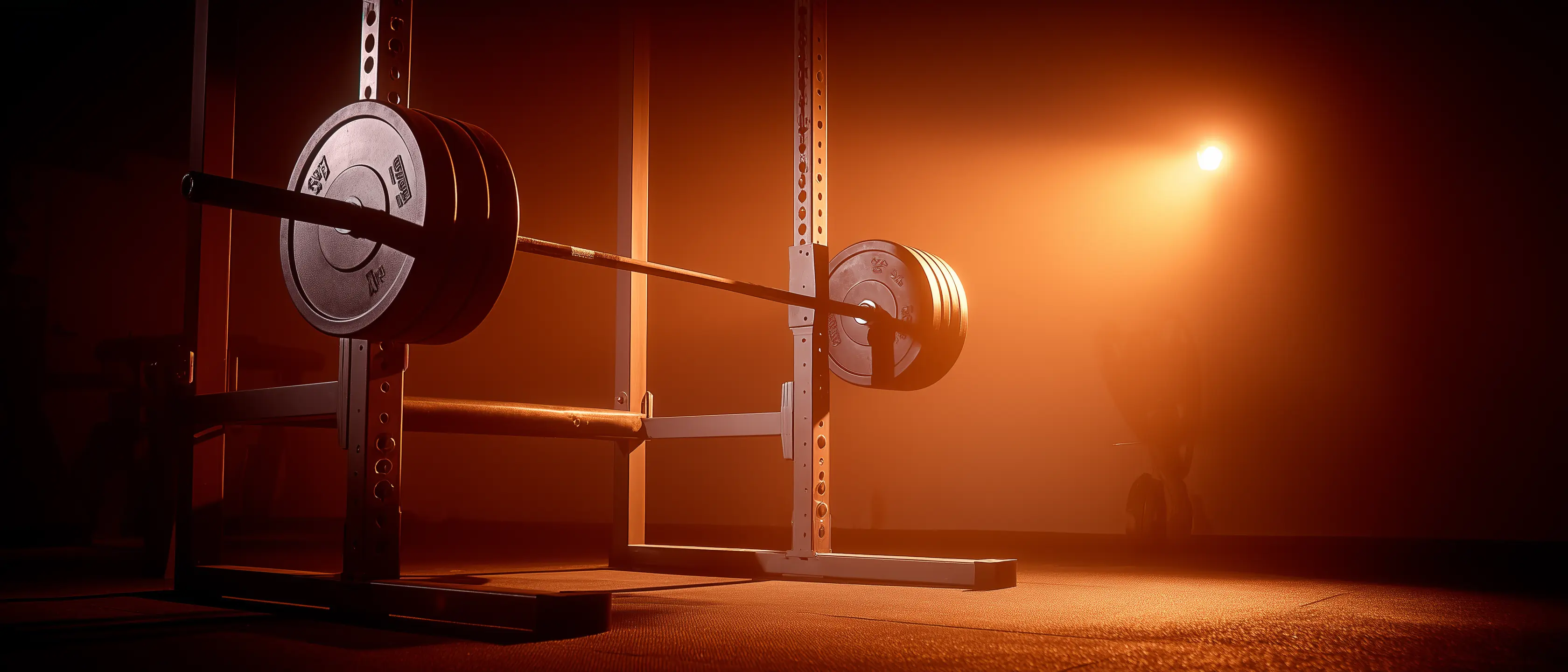
If you’re building a home gym for any 5x5 program, the power rack is the decision that matters most. Not the barbell. Not the plates. The rack.
The reason is simple: the power rack is what keeps you safe. When you’re squatting alone in your garage and the weight pins you at the bottom, the safety bars catch the bar. When you fail a bench press rep with no spotter, the safeties stop the bar from crushing your chest. Every other piece of equipment moves weight. The rack protects you from it.
Here’s how to choose the right one.
Why a power rack is essential for 5x5 at home
5x5 is built around two lifts that can pin you under a loaded barbell: the squat and the bench press. In a commercial gym, you can ask for a spot. At home, you train alone. That changes the safety equation entirely.
Squats without a spotter
A failed squat means you’re stuck at the bottom with a heavy barbell on your back. Without safeties, your options are dumping the bar backward (risky, damages floors, can hit your heels) or collapsing forward (dangerous). With a power rack, you simply lower into the safety bars, duck out from under the bar, and stand up. No drama.
This isn’t a hypothetical concern. On 5x5, you add weight every session. Eventually you’ll miss a rep. It’s part of the program. A rack makes that a non-event rather than a trip to the emergency room.
Bench press without a spotter
The bench press is arguably more dangerous than the squat without safeties. A failed squat lets you at least try to dump the bar. A failed bench press drops a loaded barbell onto your chest, throat, or face. The “roll of shame” (rolling the bar down your torso to your hips) works at lighter weights but becomes impractical as loads increase.
Safety bars set just below chest height let you fail a bench rep safely. The bar rests on the safeties instead of on you. This alone is worth the price of a rack.
Built-in versatility
Beyond safety, a power rack gives you a fixed structure for pull-ups, band work, and eventually accessories like dips and cable attachments. It’s the foundation of a complete home gym.
Types of racks
Not all racks are created equal. The three main categories each make different tradeoffs between safety, space, and cost.
Full power rack (cage)
Four vertical posts connected by horizontal crossbars, forming a cage you stand inside. Safety bars or straps run between the front and rear posts on each side.
Pros:
- Maximum safety - safeties on all sides contain the barbell completely
- Most stable design - four posts and crossbars create a rigid structure
- Most attachment options - pull-up bar, dip handles, cable pulley, lat pulldown
- Can bolt to the floor for zero wobble
Cons:
- Largest footprint (120 x 120 cm minimum, plus loading space on all sides)
- Most expensive ($400-800 for a good one)
- Heavier and harder to move
Best for: anyone with the space and budget. The full cage is the gold standard for home 5x5 training.
Half rack
Two connected uprights with forward-extending safety arms. You stand in front of the uprights rather than inside a cage.
Pros:
- Smaller footprint than a full cage
- Cheaper ($250-500)
- Safety arms still catch failed squats and bench presses
- Often includes plate storage pegs
Cons:
- Less containment - no rear posts to stop the bar if you dump it backward
- Slightly less stable than a four-post cage
- Fewer attachment options
Best for: lifters with limited space or budget who still want proper safety features.
Squat stands
Two independent uprights that aren’t connected. The most basic option.
Pros:
- Cheapest ($100-250)
- Smallest footprint and most portable
- Easy to move or store
Cons:
- Least stable - can wobble or tip under heavy loads
- No built-in safeties (must purchase separate safety arms, and even then they’re less secure)
- Very limited attachment options
- Can shift or walk across the floor during heavy squats
Best for: extremely tight budgets or spaces where a larger rack won’t fit. Not ideal for long-term serious training.
The recommendation for 5x5 is clear: get a full power rack if you have the space, or a half rack if you don’t. Squat stands are a last resort.
Key features to look for
Once you’ve decided on a type, these are the specifications that separate a good rack from a frustrating one.
Hole spacing
This is the single most overlooked feature and one of the most important. Hole spacing determines how precisely you can position the J-hooks (where the bar sits) and safety bars.
Standard spacing is 5 cm (2 inches) throughout the rack. This works but can leave you in a situation where one position is too high and the next is too low for your bench press safety height.
Westside hole spacing uses tighter 2.5 cm (1 inch) spacing through the bench press zone (roughly the middle third of the uprights). This lets you dial in the exact safety height so the bars catch a failed bench press just below your chest arc without interfering with your range of motion.
Westside spacing costs slightly more but is absolutely worth it. The difference between a safety bar that’s 2.5 cm too high (blocks your bench reps) and one that’s right (catches failures without interfering) is the difference between a useful feature and a useless one.
Weight capacity
Look for at least 300 kg (660 lbs). This isn’t about how much you plan to squat today - it’s about build quality and longevity.
A rack rated for 300+ kg uses thicker steel (typically 2.5 x 2.5 inch or 3 x 3 inch uprights with 11-gauge or heavier steel). These racks don’t flex, wobble, or feel flimsy under load. A rack rated for 200 kg uses thinner steel and will feel sketchy long before you reach that limit.
Weight capacity is a proxy for overall construction quality. Higher-rated racks have better welds, tighter tolerances, and thicker hardware.
Pull-up bar
Most power racks include a pull-up bar across the top. This is valuable for chin-ups and pull-ups, which complement 5x5 perfectly. Look for a bar with multiple grip positions: wide, narrow, and neutral (palms facing each other).
Some racks offer a fat bar option (thicker diameter) that also doubles as grip training.
Band pegs and plate storage
Band pegs on the base of the rack let you attach resistance bands for accommodating resistance training down the road. Not essential for 5x5, but a nice feature if you plan to use the rack for years.
Plate storage pegs on the rear uprights keep your plates organized and add weight to the rack for stability. This is especially useful for racks that aren’t bolted down.
J-hook quality
The J-hooks are what hold the bar when you rack and unrack. Cheap racks use bare steel J-hooks that scratch your barbell’s knurling over time. Better racks line the J-hooks with UHMW plastic or nylon to protect the bar.
Also check J-hook depth - too shallow and the bar can roll off; too deep and unracking for bench press becomes awkward.
Size considerations
Ceiling height
This is the constraint that catches most people off guard. You need clearance above the rack for overhead press.
Measure your ceiling height first. Then:
- Subtract the rack height (typically 200-220 cm for a standard rack)
- You need at least 30 cm above the rack for overhead press with a loaded barbell
- Ideally 45-60 cm for comfortable pressing
If your ceiling is 240 cm (8 feet), a 210 cm rack leaves only 30 cm of clearance - tight but workable for shorter lifters. If you’re tall or have a low ceiling, look for a short rack (180-190 cm) or plan to do overhead press outside the rack.
Some racks come in multiple height options. A “short” version designed for basement gyms with 210 cm ceilings is a common offering.
Footprint and room layout
The rack itself takes up roughly 120 x 120 cm. But you need to account for:
- Barbell overhang: A 220 cm barbell extends about 50 cm past each side of the rack. You need clearance for loading plates.
- Walkout space: For squats, you need 90-120 cm behind the rack (or in front, depending on which direction you face) to step back and set up.
- Bench space: Your bench sits inside or in front of the rack and extends roughly 120 cm.
Total practical footprint: roughly 3 x 3 meters. A single-car garage handles this easily. A spare bedroom works if you don’t mind the commitment.
Flooring
A power rack on bare concrete or hardwood is a bad idea. The rack can scratch and dent the floor, dropped plates cause damage, and the noise travels through the house.
Rubber gym mats (horse stall mats from a farm supply store are the go-to: 1.9 cm thick, roughly $45 per 120 x 180 cm mat) solve all three problems. Lay 2-3 mats under and around the rack. They protect the floor, reduce noise, and give you stable footing.
For deadlifts specifically, consider building a simple platform: a sheet of plywood sandwiched between two layers of rubber mats. This absorbs the impact of heavy deadlifts being set down and protects both the floor and your plates.
Budget tiers
Entry level: $200-400
At this price, you’re looking at racks from Titan Fitness, Rep Fitness PR-1000 series, or similar budget brands.
What you get:
- 2 x 2 inch or 2 x 3 inch steel uprights
- 300 kg weight capacity (usually)
- Standard hole spacing (5 cm throughout)
- Basic J-hooks and safety bars
- Pull-up bar
What you give up:
- No Westside hole spacing
- Thinner steel that may wobble slightly
- Basic J-hooks without protective lining
- Limited attachment options
For a beginner on 5x5, an entry-level rack does the job. You can squat, bench, and press safely. It won’t feel premium, but it’s infinitely better than squat stands or no rack at all.
Mid-range: $400-800
This is the sweet spot. Racks from Rep Fitness PR-4000 series, Titan T-3, Rogue RML-390F, or similar.
What you get:
- 3 x 3 inch steel uprights (11-gauge)
- 450+ kg weight capacity
- Westside hole spacing
- UHMW-lined J-hooks
- Better hardware and welds
- More attachment options (dip handles, cable pulleys available)
- Plate storage pegs
This tier represents the best value for a long-term home gym. The rack will handle any weight you’ll realistically lift and accept accessories as your training evolves.
Premium: $800+
Racks from Rogue Monster series, Sorinex, EliteFTS, or similar competition-grade manufacturers.
What you get:
- 3 x 3 inch steel uprights (7-gauge or heavier)
- 600+ kg weight capacity
- Perfect tolerances and finish
- Extensive attachment ecosystem
- Built to last generations
Unless you’re an advanced lifter or just want the best regardless of cost, the premium tier is overkill for 5x5. The mid-range delivers 95% of the performance at half the price.
What else you need alongside the rack
A power rack alone doesn’t make a gym. Here’s the complete list for home 5x5 training:
Barbell ($150-400): A standard 20 kg Olympic barbell fits all power racks and handles every 5x5 exercise. This is your second most important purchase. Read more in our barbell guide.
Weight plates ($250-600): Start with at least 150 kg worth of plates (including 2.5 kg and 1.25 kg plates for small jumps). Iron plates are cheapest; bumper plates are quieter and can be dropped safely.
Flat bench ($100-300): Needed for bench press. Doesn’t need to be adjustable for 5x5 - a solid flat bench works. Check that it fits inside your rack with room for you to set up.
Rubber flooring ($50-150): Horse stall mats or interlocking gym tiles. Protects floors, reduces noise, provides stable footing.
Optional but recommended: Chalk or liquid chalk for grip, microplates for smaller weight jumps on overhead press, and a mirror for form checks.
Don’t cheap out on safety
It’s tempting to save money on the rack and spend more on a nice barbell or plates. Resist that temptation. You can upgrade a barbell later. You can add plates over time. But the rack is what stands between you and a barbell on your neck when a squat goes wrong.
A good power rack lasts decades. Amortize the cost over thousands of workouts and even the premium tier costs pennies per session. The budget tier costs fractions of a penny.
Buy the best rack you can afford, set it up properly, and train with confidence knowing that when you push yourself to failure - which any serious program will eventually demand - the safeties have you covered.
Track every home gym session and your progression through the program. Download Lift5x5 free →
Track your 5x5 progress automatically
Built-in plate calculator, rest timer, and auto-progression. Free for iOS & Android.
Helping lifters get stronger with the simplest program that works. No BS, just barbells.